

 Please Note: A link at the bottom of this page will provide access to a gallery of additional pages devoted to various of the flags used during the American Revolutionary War period.
Also: The flags included in these pages represent only a few of the flags that were used during the American Revolutionary War. There was no attempt to make this collection into a definitive inventory of all the known flags. The examples rendered in the pages of the Gallery are intended to illustrate the diversity of the flags that our Patriot ancestors used to display their Patriotism.
The word flag usually refers to a form of banner representing a geo-political body (such as a Nation, Country, State, etc.), and which, in an heraldic way, is used as a symbol of that geo-political body. The words colors, ensign and standard are, in a way, just synonyms for the word flag.
But, especially in regard to, or during, a time of war (such as the American Revolutionary War) the word colors [variously, colours] specifically refers to flags used in the military, as compared to flags used by private citizens. The word, colors, usually refers to a form of banner used by a military unit (such as a Regiment, Battalion, etc) as a means for it to be identified and differentiated from other military units.
The word ensign usually refers to the colors employed by the Navy. Air craft often display a national flag, which is also called an ensign.
The word standard specifically refers to flags used by, or representing, a chief of state of a nation or a commander-in-chief of a military body.
Since this website will be discussing the flags created and used by the Patriots of the American Revolutionary War both on land and sea, it is appropriate that they be called either colors, ensigns and standards.
The use of the word colors to refer to a flag derives from the practice of heraldry in the Medieval Age. In heraldry, it refered to the ‘colors’ incorporated in the field, or background, of the banner. Each element of an heraldic design (formally titled an achievement and informally known as a coat of arms) signified something, and the color of those elements either augmented or emphasized the signification. During the Medieval Age, armies were paid by, and therefore their members were loyal to, particular individuals. Those individuals, whether they were kings, dukes, knights or whatever, would have the right to bear heraldic achievements by which they could be distinctly identified. Banners and flags, colors and standards were created as signs to identify the armies which carried them into battle. And so, the heraldic designs which decorated them were those possessed by the leaders of the armies. In other words, initially there were no ‘national’ flags or colors per se. Colors and standards carried on the battlefield by the soldiers were not theirs by right of citizenship, but rather their leader’s and the soldiers simply carried them because they were being paid to. The heraldic designs which came to be regarded as ‘national’ designs, such as the British ‘Royal Standard Of The United Kingdom’, derived from the British monarchy’s own heraldic achievements.
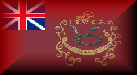
As the Americans of the 1770s began to form ideas of gaining their independence from the mother country of Great Britain, and their sense of loyalty to her began to diminish; the need for colors that reflected their burgeoning new identity became evident. It should be remembered that, at least initially, quite a number of the delegates to the Continental Congress advocated maintaining a cordial relationship with Great Britain. The Olive Branch Petition was evidence of this desire by many to not sever the apron strings immediately. It was only after King George III’s refusal to take into consideration any of the colonists’ concerns that an absolute severance of the ties to England was even considered by the Patriots. It can therefore be understood why the first colors to be created by the Patriots included the Union Jack in their designs. The distinctive pattern of the Union Jack had been inserted in the canton (i.e. the upper left quarter), on a field of red during the reign of Queen Anne. It has generally been called the British Red Ensign. And in some cases, the word ‘Liberty’ in white letters was added to the field of red.
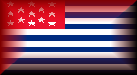
The Patriots’ colors started out with the stripes. A date when the stripes were first chosen to form the field of the design of the Patriots’ colors cannot be pinpointed with accuracy. David Hackett Fischer, in his book, Liberty And Freedom, states that the “Union Flag” of the Sons of Liberty, was seen in Boston as early as 1773. In the caption of an illustration of a Liberty Flag, the date of 1765-66 suggests an earlier beginning. Edward W. Richardson, in his book, Standards And Colors Of The American Revolution, stated that the vertical stripes of the Sons of Liberty flag probably were inspired by Paul Revere’s engraving (of Ben Franklin’s sketch) of the snake cut into nine parts representing the, then, un-united colonies. That engraving was not published until 1774. Whether the Sons of Liberty flag was based on the Revere engraving, and whether it was in use as early as 1765, when the Sons of Liberty were organized cannot be confirmed.
The earliest documented reference to any colors created by the Patriots appeared in the Boston Evening Post for Monday, 24 October, 1774. In that issue it was reported that:
“We have juƒt received the following intelligence from Taunton – that on Friday laƒt a liberty pole 112 feet long was raiƒed there on which a vane, and a Union flag flying with the words Liberty and Union thereon.”
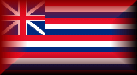
The vertical stripes of alternating red and white were, at some point, rotated so that they would lie horizontally. Commonly referred to as the “Rebel Stripes”, these colors were flown on naval vessels well into the 1790s. The addition of the Union Jack to the canton resulted in what was known as the Continental Union, Continental Colors or (by Nineteenth Century writers) the Continental Grand Union Flag.
The Continental Union Flag was raised on Prospect Hill in Cambridge, Massachusetts on the first day of January, 1776. But the British assumed that the addition of the Union Jack to the Rebel Stripes was a signal for surrender. General Washington wrote to Joseph Reed on the 4th of January that:
“We had hoiƒted the union flag in compliment to the United Colonies. But, behold, it was received in Boƒton as a token of the deep impreƒsion the ƒpeech had made upon us, and as a ƒignal of ƒubmiƒsion.”
Another problem for the new Continental Union Flag was that it was not actually new and unique. The colors of the British East Indies Company also consisted of the Union Jack in the canton, on a field of nine horizontal red and white stripes. Needless to say, the Patriots soon dispensed with the Union Jack, and began to think about a different design.
In the spring of 1777 an Indian, by the name of Thomas Green, had written to Thomas Wharton, the president of the Supreme Executive Council of Pennsylvania. According to the entry entered into the Minutes of the Supreme Executive Council for Tuesday, 3rd June 1777:
“His Excell’y the Preƒident laid before the Council three Strings of Wampum, which had been delivered to him ƒome time before by Thomas Green, a Nominal Indian of the -----Nation, requeƒting that a Flag of the United States might be delivered to him, to take to the Chiefs of his Nation, to be uƒed by them for their ƒecurity & protection, when they may have occaƒion to viƒit us…”
Green’s request was forwarded to the Continental Congress on 03 June, 1777. Francis Hopkinson of New Jersey, and head of the Marine Committee, was given the task to respond to the request. Hopkinson therefore laid claim to having created the design of the national colors as we know it.
During the 14 June, 1777 session of the Continental Congress, it was resolved that:
“The flag of the (thirteen) United States be thirteen ƒtripes, alternate red and white: that the union be thirteen ƒtars, white in a blue field, repreƒenting a new conƒtellation.”
The delegates to the Continental Congress did not specify how the thirteen stars should be arranged on the blue field. As a result, different designs proliferated.
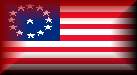
It should be noted that the tradition of Betsy Ross stitching together the first Stars and Stripes flag, at the request of George Washington, George Ross and Robert Morris did not come into existence until the year 1870. The tradition was started by Betsy’s grandsons, William Canby and George Canby. Although Betsy Ross was in fact a seamstress, and is known to have produced flags for the Patriot Cause, there is no evidence that she made the first national colors. Nor is there any factual evidence that Betsy Ross originated the design in which the thirteen stars are positioned in a circle on the blue field. The name Betsy Ross Flag, in regard to a flag with the stars in a circle on the blue field on the canton, was not popularized until the time of the nation’s Centennial.
Of lesser notoriety was the Philadelphia milliner by the name of Margaret Manny. It was she who, in the fall of 1775, stitched together a red and white striped Sons of Liberty flag with the combined crosses of St. Andrew and St. George in the canton. James Wharton supplied Miss Manny with forty-nine yards of broad bunting and fifty-two and one-half yards of narrower bunting for an ensign destined to be flown on the flagship of the American squadron, the Alfred. On 03 December, 1775, Captain John Paul Jones hoisted the new colors produced by Miss Manny on the Alfred.
The Continental Union colors stitched by Margaret Manny was also flying from the mast of the Andrew Doria on 16 November, 1776 as it sailed into the port of the West Indies island of St. Eustatius. The Andrew Doria was headed for Fort Orange on the Dutch island of St. Eustatius to obtain military supplies and also to deliver a copy of the Declaration of Independence to its governor, Johannes de Graaf. Isaiah Robinson, captain of the Andrew Doria fired a salute from the guns of the brig-of-war. If Captain Robinson would have struck his colors, and the salute had come from an unmarked ship, no importance would have been attached to what happened next. But the salute came from a warship flying the flag of the newly declared independent United States of America. Governor de Graaf gave orders for the guns of Fort Orange to fire a salute in reply, and in that moment the first formal recognition of the United States of America by a foreign nation took place.