Clan Name
 |
Gaelic Name |
The Clan's Origin ~ Factual & Theoretical |
Principal Hereditary Lands |
Septs & Branches |
Heraldic Badge |
Motto |
Plant or Heraldic Badge |
| AGNEW |
|
This family is believed by some to have a Norman ancestry, but by others to have been descended from the Ulster sept of O'Gnimh, the hereditary bards of Clan Aodha Bhuidhe. |
Galloway & Wigtownshire |
|
An eagle issuant and reguardant, proper |
Consilio non impetu (By wisdom not by force) |
|
| Anderson |
Mac Ghille Aindrais |
The Anderson clan obtained its name from Andrew, the patron saint of Scotland, as does Clan MacAndrew. The Andersons were part of the Clan Chattan confederacy. |
Badenoch, Islay & Peebleshire |
Candacraig in Strathdon, Dowhill, Wester Ardbreck |
An oak tree proper |
Stand Sure |
Oak tree |
| ANSTRUTHER |
|
The lands of Anstruter in Fife were granted to William de Candela, a Norman. It is from William that the clan descends. |
Balcaskie (Fife) |
|
Two arms in armour holding a pole-ax with both hands gauntleted proper |
Periissem ni periissem (I would have perished had I notpersisted) |
Olive sprig |
| ARBUTHNOTT |
|
The name of this clan is derived from the lands of the same name in Kincardineshire. Hugh, of the family of Swinton, acquired the lands of Arbuthnott through his marriage to the daughter of Osbert Olifard, during the reign of William the Lion. |
Kincardineshire |
|
A peacock's head couped at the neck proper |
Laus deo (Praise God) |
A peacock's head |
| Armstrong |
Mac Ghillielaidir |
A King of the Scots had his horse killed under him. His armour-bearer, a man by the name of Fairbairn, lifted the king onto his own horse. The king gave him the name of "Strong Arm". |
Liddesdale & Borders |
Armstrong of Kilnockie, Fairburn, Nixon |
An arm embowered, proper |
Invictus maneo (I remain unvanquished) |
Muscular, bent arm |
Clan Name
 |
Gaelic Name |
The Clan's Origin ~ Factual & Theoretical |
Principal Hereditary Lands |
Septs & Branches |
Heraldic Badge |
Motto |
Plant or Heraldic Badge |
| Baird |
Mac a'bhaird |
William the Lion was said to have been saved from being gored by a wild boar by a man from the village of Baird in Lanarkshire. |
Aberdeenshire & Lanarkshire |
Cambusnethan, Bard |
An eagle's head erased, proper |
Dominus fecit (The Lord made) |
Eagle's head |
| BANNERMAN |
|
The family held the privilege of carrying the royal standard during the 10th and 11th Centuries after their ancestor Sir Alexander Carron distinguished himself in battle. |
Aberdeen, Clyntrees, Waterton & Welltown |
|
A demi man in armour holding in his right hand a sword proper |
Pro patria (For my country) |
|
| BARCLAY |
|
The family came to the British Isles with William the Conqueror. The original spelling of the name in its French form was de Berchelai. |
Aberdeenshire, Glouchestershire & Kincardineshire |
Berkeley, Mathers, Tolly |
Out of a chapeau azure turned ermine a hand holding a dagger, proper |
Aut agere aut mori (Either action or death) |
Hand holding a dagger, stretching out of a hat |
| BORTHWICK |
|
The name of this clan is derived from the lands that bordered on the Borthwick Water in Roxburghshire. The clan is of very ancient origins and is believed to have come to Britain with Caesar's legions. A tradition states that the clan descends from Andreas, who accompanied Edgar the Aetheling and his sister, Margaret, to Scotland in 1067. |
Roxburghshire |
|
A moor's head couped proper wreathed argent and sable |
Qui conducit (He who leads) |
A stem of two roses Gules leaved, barbed and seeded vert |
| BOYD |
Buidhe |
The Gaelic word, Buidhe means 'fair' or 'yellow.' One tradition states that the clan takes its name from the description of the fair colored hair of Robert, the nephew of Walter, the first High Steward of Scotland. Another tradition states that the name is derived from the Gaelic word boid, meaning 'from Bute.' |
Ayrshire |
Boyd of Merton, Boyd of Penkill, Boyd of Pitcon, Boyd of Trochrig |
A dexter hand erect in pale having the two outer fingers bowed inwards |
Confido (I trust) |
A fan of laurel leaves set behind a hand |
| BOYLE |
|
This clan's name comes from the Norman town of Beauville near Caen. |
Ayrshire |
|
A double headed eagle displayed, parted per pale embattled gules and argent |
Dominus providebit (The Lord will provide) |
|
| BRODIE |
Brothaigh |
The family traces its origins to the Picts. It is believed that the clan shares a common ancestry with the Morays and Inneses. |
Morayshire |
Brodie of Brodie, Brodie of Lethen, Brodie of Moray, Bryde |
A dexter hand holding a sheaf of arrows, proper |
Unite |
Periwinkle |
| BRUCE |
Brus |
Adam de Brus came over with William the Conqueror, who made him a baron. |
Annandale, Clackmannan, Carrick & Elgin |
Bruce of Airth, Bruce of Clackmannan, Bruce of Kennet, Bruce of Kinnaird, Brus, Carlyle, Randolf, Stenhouse |
A lion statant with tail extended, azure, armed and langued gules |
Fuimus (We have been) |
Rosemary |
| BUCHAN |
|
This clan's name is derived from the district of Buchan in Aberdeenshire and part of Banffshire. |
Aberdeenshire & Auchmacoy |
Buchan of Auchmacoy, Basken, Baskin, Bede, Bichan, Bonnieville, Boyne, Buchan, Buck, Buckie, Bucky, Cawsell, Chapp, Chrystal, Clapperton, Coscrach, Costie, Costy, Cranach, Crannach, Cruddon, Cruden, Crudon, Crystal, Crystall, Fitchie, Fitchy, Gammerie, Gammery, Hardin, Hardman, Hardnan, Kermack, Leisk, MacCrystal, Meason, Merson, Mondie, Mondy, Mundie, Mundy, Nible, Niblo, Ogston, Ogstone, Ogstoun, Prince, Ratcliff, Ratliff, Rattcliff, Rattliff, Runcie, Runcy, Shakle, Tarves, Tarvis, Teunion, Teunon, Tewnion, Tinnon, Tucks, Wadsworth, Wadsworther, West, Whammond, Whyman, Whymon, Willgook |
A sun shining upon a sunflower full blown proper |
Non inferiora secutus (Not having followed mean pursuits) |
Sunflower |
| Buchanan |
Buth Chanain -or- Canonach |
Anselan o'Kyan, a prince of Ulster landed in Argyll in 1016 and rendered service against the Danes. In 1225 the island of Clarinch in Loch Lomond was granted by the Earl of Lennox to Absalon son of MacBeth. Absalon took the name of Buchanan from the lands opposite the island of Clarinch on the shores of Loch Lomond. |
Lands east and north of Loch Lomond & Lennox |
Buchanan of that Ilk, Buchanan of Arnprior, Buchanan of Auchmar, Buchanan of Carbeth, Buchanan of Drumakill, Buchanan of Leny, Bouchannane, Colman, Cormack, Cousland, Dewar, Donleavy, Donlevy, Dove, Dow, Dowe, Gibb, Gibbon, Gibson, Gilbert, Gilbertson, Harper, Harperson, Leavy, Lennie, Lenny, MacAldonich, MacAlmon, Macandeoir, MacAslan, MacAslin, MacAuselan, MacAuslan, MacAusland, MacAuslane, MacCalman, MacCalmont, MacCammon, MacCammond, MacCasland, MacChruiter, MacColman, MacCormack, MacCormick, MacCubbin, MacCubbing, MacCubin, Macdonleavy, MacGeorge, MacGibbon, MacGilbert, MacGreusich, MacGubbin, MacInally, MacIndeor, MacIndoe, Mackinlay, Mackinley, Maclay, MacMaster, MacMaurice, MacMurchie. MacMurchy, MacNeur, MacNiur, MacNuyer, MacQuattie, MacWattie, MacWattie, MacWhirter, Masters, Masterson, Masterton, Morrice, Morris, Morrison, Murchie, Murchison, Richardson, Risk, Rusk, Ruskin, Spittal, Spittel, Walter, Walters, Wason, Waters, Watson, Watt, Watters, Weir, Yuill, Yuille, Yool, Yule, Zuill |
A dexter hand couped at the wrist, holding up a chapeau tasseled with a rose gules, all within a laurel wreath, proper |
Clarior hinc honos (Brighter hence the honour) |
Bilberry, Oak |
| BURNETT |
|
Deriving its name from the Saxon word, beornheard, which means 'bear hand', this clan held lands in England before the Norman conquest. Alexander Burnett was rewarded by Robert Bruce for his service with a grant of land in the royal Forest of Drum, and the title of 'forester.' |
Roxburghshire |
Burnett of Barns, Burnett of Craigmyle, Burnett of Crimond, Burnett of Kemnay, Burnett of Leys, Burnett of Monboddo |
A cubit arm, the hand naked, vested vert doubled argent pruning a vinetree with a pruning knife proper |
Virescit vulnere virtus (Her virtue flourishes by her wounds) |
Holly leaves |
Clan Name
 |
Gaelic Name |
The Clan's Origin ~ Factual & Theoretical |
Principal Hereditary Lands |
Septs & Branches |
Heraldic Badge |
Motto |
Plant or Heraldic Badge |
| CAMERON |
Camshron -or- Cam Brun |
This clan is reputed to be one of the more ancient clans of Scotland, originating in the 12th Century. It evolved to be composed of three main branches: MacMartins of Letterfinlay, MacGillonies of Strone & MacSorlies of Glen Nevis. The name Cameron is a place name meaning 'crooked hill' and was located in the kingdom of Fife. It is traditionally believed that the Camerons descend from Clan MacDuff. |
Northern Argyll, Lochaber & Locheil |
Cameron of Erracht, Cameron of Fassifern, Cameron of Inverailort, Cameron of Lochiel, Chalmers, Clark, Clarke, Clarkson, Clerk, Lonnie, MacAlonie, MacChlerich, MacClerich, MacChlery, MacGillome, MacGillonie, Macildowie, MacKail, MacLerie, MacMartin, MacOnie, MacOurlic, MacPhail, MacSorley, MacUlric, MacVail, MacWalrick, Martin, Paul, Sorley, Taylor |
A sheaf of five arrows tied with a band, gules |
Aonaibh ri cheile (Unite) |
Oak, Crowberry |
| CAMPBELL |
Caimbeul |
Clan tradition states that the Campbells are descended from Diarmaid, a Fingalian hero who slayed a venomous wild boar. Other traditions state that the clan originated among the ancient Britons of Strathclyde. The name Cam-beul means 'crooked mouth' in Gaelic. Certain of the clan trace their origin to Duncan mac Duibhne, a chieftan of Lochawe of the 13th Century who was the descendant of Diarmaid. |
Argyll, Breadalbane, Cawdor & Loudoun |
Campbell of Argyll, Campbell of Breadelbane, Campbell of Cawdor, Campbell of Glenlyon, Campbell of Loudoun, Campbell of Melfort, Arthur, Bannatyne, Burnes, Burness, Burnett, Burns, Caddell, Cadel, Calder, Callum, Cattell, Connochie, Conochie, Denoon, Denune, Fisher, Gibbon, Gibson, Harres, Harris, Hastings, Hawes, Haws, Hawson, Isaac, Isaacs, Iverson, Kellar, Keller, Kissack, Kissock, Lorne, Loudon, Loudoun, Lowdon, MacCartair, MacCarter, MacColm, MacColmbe, MacConachie, MacConchie, MacConnechy, MacConnochie, MacDermid, MacDiarmid, MacEller, MacElvie, MacGibbon, MacGlasrich, MacIsaac, MacIver, MacIvor, MacKellar, MacKelvie, MacKerlich, MacKerlie, MacKessack, MacKessock, MacKissock, MacLaws, Maclehose, MacNicol, MacNocaird, MacOnachie, MacOran, MacOwan, MacOwen, MacPhedran, MacPhun, MacTause, MacTavish, MacThomas, MacUre, MacVicar, Moore, Muir, Ochiltree, Pinkerton, Taweson, Tawesson, Thomas, Thomason, Thompson, Thomson, Torrie, Torry, Ure |
A boar's head, fesswise, couped, or |
Ne obliviscaris (Forget not) |
Fir club moss, Bog myrtle |
| |
|
|
|
Campbell of Breadelbane, MacDermid MacDermott MacDiarmid |
A boar's head, erased, proper |
Follow me |
|
| |
|
|
|
Campbell of Cawdor, Caddell Cadell Calder Cattell Torrie Torry |
A swan, proper, crowned, or |
Be mindful |
|
| CARMICHAEL |
|
The clan traces descent from Sir John de Carmichael of Meadowflat, who served with the Scottish army in France in the 15th Century. |
Carmichael & Lanarkshire |
Carmichal, Carmichel, Carmicheal, Carmicle, Carmchael, Carmickle, Carmickael, Carmitchal, Carmiggelt, Karmiggelt, Kermicle |
A dexter hand and arm in pale armed and holding a broken spear proper |
Tout jour prest (Always ready) |
A horse of war argent furnished gules within a circular wreath azure and gules |
| CARNEGIE |
|
The name comes from the barony of Carnegie, which were granted to John de Balinhard in 1358. Duthac de Carnegie acquired lands in Forfarshire in the early part of the 1400s. |
Carmylie & Forfarshire |
|
A thunderbolt proper, winged or |
Dread God |
|
| CATHCART |
|
Rainaldus de Kethcart owned lands along the River Cart in the 12th Century. |
Cathcart & Renfrewshire |
|
A dexter hand couped above the wrist and erect proper, grasping a crescent argent |
I hope to speed |
|
| CHARTERIS |
|
The clan takes its name from the city of Chartres in France, from which William, a son of the Lord of Chartres came along with the Normans of William the Conqueror. |
Perthshire |
Charteris of Amisfield, Charteris of Kinfauns |
A dexter hand holding up a dagger paleways proper |
This is our charter |
|
| CLAN CHATTAN |
Clann Gillacatan |
Clan Chattan is a very ancient confederation (dating from the 12th Century) of nearly twenty clans and individual families that joined with the descendants of Gillechattan Mor in a league of defense against their mutual enemies. A tradition maintains that the various families which banded together in the Chattan confederacy were all descended from the Catti, a tribe of Gauls destroyed by the Romans. Gillechattan Mor was descended from the Dal Riadan King Loarn Mor, and his son King Ferchar the Long of Loarn, who died in 697. The Clan Chattan Bond of 1609 listed the following clans as members of the confederacy: Mackintosh, MacPherson, MacQueen, MacBean, MacLean of Dochgarroch, MacGillivray, Farquharson, MacPhail, Shaw, Clarl, Gow, Gillander and Davidson. |
Atholl, Badenoch, Lochaber, Mar, Moray & Strathnairn |
Macintosh, Shaw, Davidson, Macpherson, MacGillivray, MacBean, Farquharson, MacThomas, McCombie, Cattanach, Maclean, McBain, Macphail, MacAndrew, Gow, Clark, Macintyre, Crerar, Gillespie, Davidson, Gillies, Noble, Ritchie, MacHardy, Mackilligan |
A cat salient proper |
Touch not the cat but a glove (Touch not the cat without a glove) |
Red whortleberry |
| CHISHOLM |
Siosal |
Conflicting claims have been made regarding the origins of Chisholm: some claim it to be a Celtic family, some claim it to be Norman. During the reign of Alexander III, the clan was thriving in the Borders. |
Berwickshire, Moray and Roxburghshire prior to 1350; Invernesshire after 1350 |
Chisholm ofChisholme, Chisholm of Dundorne, Chisholm of Stirches, Cheseholme, Chisholme |
A dexter hand, couped at the wrist holding erect a dagger, proper, on which is transfixed a boar's head, couped, proper langued azure |
Feros ferio (I am fierce with the fierce) |
Fern |
| COCHRANE |
|
The roots of this clan are traced to a Viking invader who settled in the region of Renfrewshire at some time between the 8th and 10th Centuries. |
Renfrewshire & Paisley |
|
A horse passant argent |
Virtute et labore (By valour and exertion) |
|
| Cockburn |
|
The clan took its name from the lands of Cockburn in Berwickshire. In 1296 Sir Pere de Cockburne swore allegiance to King Edward I of England. |
Berwickshire |
|
A cock crowing proper |
Accendit cantu (He rouses us with song) |
|
| COLQUHOUN |
Mac a' Chombaich |
The clan takes its name from the lands of Colquhoun along the shores of Loch Lomond in Dunbartonshire. The clan traces its descent from the ancient rulers of Lennox, or Luss, who were Celtic priests and hereditary guardians of the crozier of St. Kessog, the martyr. In 1368 the Fair Maid of Luss, heiress to the line of Maelduin of Luss, married Sir Robert Colquhoun, and it is from their union that the present clan descends. |
Dunbartonshire & Lennox |
Colquhoun of Luss, Culchone, Cowan, Ingram, Kilpatrick, King, Kirkpatrick, Macachounich, MacCowan, MacLintock, MacManus |
A hart's head, couped, gules, attired, argent |
Si je puis (If I can) |
Dogberry, Hazel |
| COLVILLE |
|
The Norman town of Colvile, lying between Caen and Bayeux in Normandy gave this clan its name. Philip de Colville was the earliest person of the name to be found in Scotland, having witnessed a charter by Malcolm IV to the Monastery of Dunferline prior to 1159. |
Aberdeen, Ayr, Banff, Forfar, Inverness & Kincardine |
|
A hind's head couped at the neck argent |
Oublier ne puis (I cannot forget) |
|
| CRANSTOUN |
|
The name of this clan comes from the barony of Cranstoun in Midlothian |
Midlothian |
Cranston |
A crane proper dormant holding a stone in her claw |
Thou shalt want ere I want |
Strawberry |
| CRICHTON |
|
The name comes from the barony of Kreitton near Edinburgh. |
Dumfreisshire |
Crichton of Frendraught, Creighton |
A dragon spouting out fire proper |
God send grace |
|
| CUMMING |
Cuimean |
The clan traces descent from Jardine Comyn, son of the Earl of Buchan, in the 13th Century. The first of the name of Comyn, a Norman family, came to Scotland during the 11th Century. William Comyn, an Anglo-Norman, was a close friend and confidant to King David I, who gave William the title of Chancellor or Scotland. The family was at odds with Robert the Bruce, who took their lands after murdering Sir John Comyn in 1309. |
Altyre, Badenoch, Buchan, Moray & Roxburghshire |
Cumming of Altyre, Cumming of Cutler, Cumming of Inverallochy, Cumming of Relugas, Buchan, Cheyne, Chiene, Comine, Common, Commons, Comyn, Cumin, Cummin, MacNiven, Niven, Russell |
A lion rampant, or, holding in his dexter paw a dagger, proper |
Courage |
Cummin plant |
| Cunningham |
MacCuinneagain |
The clan takes its name from the district of Cunninghame in Ayrshire. Hugo de Moreville, the Constable of Scotland in the 12th Century, granted lands of Kilmaurs in Cunningham to a vassal named Warnebald. The descendants of Warnebald took the name of Cunningham. |
Ayrshire, Caprington, Corsehill & Glencairn |
Cunningham of Auchinharvie, Cunningham of Caprington, Cunningham of Corsehill, Cunningham of Craigends, Cunningham of Kilmaurs, Cunningham of Robertland, Warnebald |
A unicorn's head, argent, crined and armed, or |
Over fork over |
|
Clan Name
 |
Gaelic Name |
The Clan's Origin ~ Factual & Theoretical |
Principal Hereditary Lands |
Septs & Branches |
Heraldic Badge |
Motto |
Plant or Heraldic Badge |
| Dalrymple |
Dal 'yrmole |
The clan takes its name from the district of Dalrymple. |
Ayrshire |
|
A rock proper |
Firm |
|
| DARROCH |
Macdara |
The name of this clan comes from the lands of Darroch near Falkirk. The Gaelic name means 'son of oak' and may refer to the oak groves of the clan's native homelands. |
|
|
On a chapeau Gules furred miniver a demi-Negro, in his dexter hand a dagger proper |
Be watchfull |
|
| DAVIDSON |
MacDhaibhidh |
Known as Clan Dhai from its first chief, David Dubh of Invernahaven, the clan Davidson joined the Clan Chattan during the early 1300s. |
Cantray, Strathspey & Tulloch |
Davidson of Cantray, Davidson of Davidston, Davidson of Invernahaven, Davie, Davis, Davison, Dawson, Day, Dean, Dow, Kay, MacDade, MacDaid, MacDavid |
A stag's head, erased, proper |
Sapienter si sincere (Wisely if sincerely) |
Red whortleberry |
| DEWAR |
|
The tradition of this clan states that a wolf was ravaging the region around Heriot. A man by the name of Dewar slayed the beast and was granted lands as his reward. |
|
|
Issuant from a crest-cornet of of four (three visible) strawberry leaves, a dexter arm vambraced, brandishing a sword proper, hilted and pommelled or |
Quid non pro patria (What will a man not do for his country) |
An anchor with a serpent twisted around the shank |
| Donnachaidh |
|
See Robertson |
|
|
|
|
|
| Douglas |
Dubhghlas |
This clan descends from William de Duglas, who lived in the 12th Century. |
Angus, Dumfriesshire, Galloway, Lanarkshire |
Earls of Angus, Earls of Douglas, Earls of Lennox, Drysdale, Lockerbie, Morton |
On a chapeau a salamander, vert, in fire, proper |
Jamais arriere (Never behind) |
Salamander on a hat, ablaze |
| DRUMMOND |
Drummann |
This clan descends from Maurice, a prince of Hungary according to one tradition. Maurice would have been a grandson of Andrew, King of Hungary. Another tradition states that a man by the name of Hungarian accompanied Edgar the Aetheling and his two sisters to Scotland in their flight from William the Conqueror. |
Perthshire & Stirlingshire |
Drummond of Blair Drummond, Drummond of Concraig, Drummond of Hawthornden, Earl of Perth, Brewer, Doig, Grewer, Gruer, MacCrouther, MacGrowther, MacGruder, MacGruther, MacGrewar, MacRobbie, MacRobert, MacRobie |
Out os crest coronet a goshawk, wings expanded, proper, jessed gules |
Virtutem coronat honos (Honour crowns virtue) -or- Gang warily (Go carefully) |
Wild thyme, Holly |
| DUNBAR |
|
The clan is of Celtic origin. Gospatrick, the Earl of Northumberland received the lands of Dunbar in Lothian from Malcolm III. |
Galloway & East Lothian |
Boath, Durn, Hempriggs, Mochrum, Northfield |
A horse's head argent, bridled and reined gules |
In promptu (In readiness) |
A lion grasping the stem of a rosebush |
| Duncan |
Mac Dhonnchaidh |
The Duncans, along with the Robertsons and Clan Donnachaidh, were descended from the ancient Earls of Atholl, taking their name from Donnachadh Reanhar, or Fat Duncan, who fought at the Battle of Bannockburn in 1314. |
Atholl & Lundie in Fife |
Duncan of Camperdown, Duncan of Lundie, Duncanson |
A ship under sail |
Disce pati (Learn to suffer) |
Ship under sail |
| DUNDAS |
Dun deas |
This clan traces its origin to Helias, the son of Hutred, the younger son of Gospatrick, Earl of Northumberland. |
Firth of Forth |
|
A lion's head affrontee looking through a bush of oak proper |
Essayez (Try) |
|
| DURIE |
Dobharach |
One tradition states that this clan descends from a Gaelic origin, while another asserts that it descends from a French Norman origin. |
Fife |
|
A crescent or |
Confido (I trust) |
|
Clan Name
 |
Gaelic Name |
The Clan's Origin ~ Factual & Theoretical |
Principal Hereditary Lands |
Septs & Branches |
Heraldic Badge |
Motto |
Plant or Heraldic Badge |
| ELIOTT |
Elwald |
The Elliotts were a border clan, originating in the 16th Century. The first Elliots were designated as Redheuch. |
Borders |
Elliot of Arkleton, Elliot of Braidlie, Elliot of Larriston, Elliot of Minto, Elliot of Stobs |
A dexter cubit arm in armour, erect, in hand a broadsword, proper |
Fortiter et recte (With strength and right) |
White hawthorn |
| ELPHINSTONE |
|
This clan started under the name of de Erth and was derived from the name of the lands of Airth in Stirlingshire. The lands of the de Erth clan descended to an heiress, whose husband was of the surname de Elfinstun. A tradition of the de Elfinstun family claims that the family descended from a Flemish knight of the name Helphenstein. Another tradition states that the name is actually derived from the words Alpin's tun or rather the 'farmstead of Alpin.' |
East Lothian |
|
A lady, from the waist upwards, richly habited in red, her arms extended, the right hand supporting a tower and the left holding a branch of laurel, all proper |
Cause causit (Cause caused it) |
|
| ERSKINE |
Arascain |
Sir Henry de Erskine owned the barony of Erskine in the 13th Century. The clan were prominent in the Scots Guard in France and served under Joan of Arc. |
Alloa, Mar & Renfrewshire |
Erskine of Alva, Erskine of Cambo, Erskine of Dun, Erskine of Rerrick, Erskine of Restormell, House of Mar |
Out of cap of maintenance gules turned ermine, a dexter hand holding a dagger in pale proper |
Je pense plus (I think more) |
Left hand holding up a dagger out of a hat |
Clan Name
 |
Gaelic Name |
The Clan's Origin ~ Factual & Theoretical |
Principal Hereditary Lands |
Septs & Branches |
Heraldic Badge |
Motto |
Plant or Heraldic Badge |
| FARQUHARSON |
Mac Fhearchair |
This clan descends from Farquhar, fourth son of Alexander Ciar (Shaw) of Rothiemurchus, and as such was a member of Clan Chattan. The clan is sometimes referred to as Clann Fhionnlaidh in honor of Fionnlaidh Mor, a standard bearer, who fell in the Battle of Pinkie. |
Aberdeenshire & Invercauld |
Farquharson of Balfour, Farquharson of Craigdarroch, Farquharson of Invercauld, Farquharson of Inverey, Farquharson of Kinmundy, Farquharson of Pitfour, Barrie, Bowman, Brebner, Christie, Coutts, Farquhar, Findlay, Findlayson, Finlay, Finlayson, Greusach, Hardie, Hardy, Kerracher, Lyon, MacCaig, MacCardney, MacCartney, MacCuaig, MacEarachar, MacEaracher, MacErracher, MacFarquhar, MacHardie, MacHardy, MacKerchar, MacKerrachar, Mackindlay, Mackinlay, Reoch, Riach, Tawse |
Out of chapeau gules turned ermine a demi-lion rampant, gules, holding in his dexter paw a sword, proper pommelled, or |
Fide et fortitudine (By fidelity and fortitude) |
Red whortleberry, Scots fir |
| FERGUSSON |
Mac Fhearghuis |
A number of families were established under this name throughout Scotland at an early date. The name comes either from Fergus, a prince of Galloway, or from King Fergus, who established the Scottish Dal Riada kingdom. |
Argyll, Ayrshire, Dumfries, Galloway, Perthshire & the estate of Raith |
Fergusson of Balquhidder, Fergusson of Craigdarroch, Fergusson of Dunfallandy, Fergusson of Kinmunday, Fergus, Ferguson, Ferries, MacAdie, MacFergus, MacKerras, MacKersey |
A bee on a thistle all proper |
Dulcius ex asperis (Sweeter after difficulties) |
Pine, Poplar |
| Fletcher |
Mac an Fhleister |
The name of Fletcher appears among many of the clans, being derived from "maker of arrows". |
Argyll, Glenorchy & Perthshire |
Fletcher of Dunans |
Two naked arms proper shooting an arrow out of a bow sable |
Fletcher of Dunans |
|
| FORBES |
Foirbeis |
The clan’s name comes from the Gaelic word, forba, meaning a field or district. The clan originated in the barony of Forbes in Aberdeenshire. The first chief was John of Forbes in the 13th Century. |
Aberdeenshire |
Forbes of that Ilk, Forbes of Culloden, Forbes of Craigievar, Forbes of Moniemusk, Forbes of Tolquhoun, Berry, Bannerman, Boyes, Fordyce, Lumsden, Michie, Walters, Watt |
A stag’s head attired with ten tines proper |
Grace me guide |
Broom |
| FORSYTH |
Fearsithe |
The origin of this clan is uncertain. One tradition states it is of Celtic origin, while another claims descent from the Norseman, Forsach who settled in Aquitaine. |
Borders |
|
A griffin segreant azure, armed and membered sable, crowned or |
Instaurator ruinae (A repairer of ruin) |
Forsythia |
| FRASER |
Friseal |
The family is of Norman origin. In the 12th Century, Sir Andrew Fraser acquired the lands of Lovat through marriage to the daughter of the Earl of Orkney and Caithness. |
Aberdeenshire, Invernessshire & East Lothian |
Fraser of Lovat, Cowie, Fressell, Frew, Frezerl, Friseal, Frissell, Frizell, Macgruer, Macimmey, Mackemmie, MacKim, MacKimmie, MacShimes, MacShimmie, MacSimon, MacSymon, Oliver, Sim, Sime, Simon, Simpson, Simson, Syme, Symon, Tweedie |
On a mount a flourish of strawberries leaved and fructed proper |
Je suis prest (All my hope is in God) |
Yew |
| |
|
|
|
FRASER OF LOVAT |
A buck's head, erased, or tyned argent |
Je suis prest (I am ready) |
Yew |
Clan Name
 |
Gaelic Name |
The Clan's Origin ~ Factual & Theoretical |
Principal Hereditary Lands |
Septs & Branches |
Heraldic Badge |
Motto |
Plant or Heraldic Badge |
| Galbraith |
|
Gillescop Galbrath witnessed a charter by the Lord of Lennox in 1208. The clan Galbraith traces its descent from William, the son of Gillescop. The family claims to be descended from the Britons of the kingdom of Strathclyde. |
Lennox & Strathclyde |
Galbreath |
A bear's head erased argent, muzzled azure |
Ab obice suavior (Sweeter for there having been difficulties) |
|
| GORDON |
Gordon |
This clan was an Anglo-Norman family that settled in the Borders in the 12th Century, but moved to Aberdeenshire in the 14th Century when Sir Adam, Lord of Gordon was granted lands by Robert the Bruce. |
Aberdeenshire, Berwickshire, Deeside, Galloway & Strathbogie |
Gordon of Earlstoun, Gordon of Gordonstoun, Gordon of Lochinvar, Earls of Huntley, Adam, Addison, Adie, Aitcheson,, Aitken, Barrie, Cullen, Eadie, Edie, Geddes, Huntly, Marr, Mavor, Milne, Moir, Todd |
Out of a crest coronet a buck's head cabossed, proper, attired, or |
Bydand (Remaining) |
Rock ivy |
| Gow (MacGowan) |
Mac a'Ghobhainn |
The Gaelic word, Gobha is the root of the name Gow, meaning a blacksmith or armourer. The main branch of the clan was associated with the MacPherson Clan and was a member of the Clan Chattan. |
Dumfriesshire, Invernesshire, Perthshire & Stirlingshire |
|
A cat sejant, proper |
Touch not the cat but a glove (Touch not the cat without a glove) |
|
| GRAHAM |
Greumach |
The clan traces its history to before the 12th Century. Tradition says that a man named Gramus breached the Antonine Wall during the Roman occupation in 420 AD. Historical evidence shows that William de Graham was a knight who accompanied David I to claim his throne. |
Angus, Barony of Mugdock, Borders, Lennox, Loch Katrine, Perthshire and around Dundee and Montrose |
Graham of Balgowan, Graham of Dundee, Graham of Monteith, Graham of Montrose, Airth, Allardice, Bonar, Bontein, Bontine, Buntain, Bunten, Buntine, Graeme, Haddon, Howe, Howie, MacGibbon, MacGilvernock, MacGrime, Menteith, Monteith |
A falcon wings displayed, proper, beaked and armed, or, preying on a stork on its back argent, armed gules |
Ne oublie (Do not forget) |
Spurge laurel |
| GRANT |
Grannd |
Clan Grant was part of the confederation known as the Siol Alpine, who claimed descent from King Kenneth MacAlpin. Another tradition states that they descended from a Norman, Gregory le Grant, who acquired lands in Invernesshire by marrying into the Bisset clan. |
Glen Moriston, Glen Urquhart, Loch Ness, Rothiemurchus & Strathspey |
Grant of Glenmoriston, Grant of Monymusk, Grant of Strathspey, Gilroy, MacGilroy, Macilroy, Pratt, Suttie |
A mountain inflammed, proper |
Stand fast |
Scots pine |
| GRIERSON |
|
A tradition states that this clan came from the same stock as the MacGregor clan. The family traces its ancestry to Gilbert Grierson who, in 1420 was the armour bearer to the Earl of Douglas |
|
|
A fetterlock argent |
Hoc securior (More secure by this) |
Bluebell |
| Gunn |
Guinne |
The clan claims descent from Gunni, the son of Olave the Black, a Norse King of Man and the Isles. The name derives from the Norse word for ‘battle’. Gunni acquired Caithness through his marriage to Ragnhild, the widow of Lifolf 'Baldpate'. Ragnhild was the granddaughter of Saint Ragnvald (St. Ronald) Jarl of Orkney. Ragnvald was descended from Turf Einar, Jarl of Orkney. |
Caithness & Sutherland |
Gunn of Banniskirk, Gunn of Kilernan, Enrick, Gallie, Gaunson, Georgeson, Jameson, Jamieson, Johnson, Kean, Keene, MacComas, MacCorkill, MacCorkle, MacIan, MacKames, MacKeamish, MacKean, MacManus, MacOmish, MacRob, MacRobb, MacWilliam, Mann, Manson, Nelson, Robinson, Robison, Robson, Ronald, Ronaldson, Sandison, Swan, Swanson, Will, Williamson, Wilson, Wylie |
A dexter hand holding a sword in bend all proper |
Aut pax aut bellum (Either peace or war) |
Juniper Roseroot |
| GUTHRIE |
Gaothairach |
A tradition states that the lands of Guthrie, and hence the clan that derived its name from the lands, were named by an early Scots king after a fisherman "gut three" fish to serve to his monarch. King William the Lion granted the lands of Gutherin to the Abbey of Arbroath circa 1178. |
Angus |
|
A dexter arm holding a drawn sword proper |
Sto pro veritate (I stand for the truth) |
|
Clan Name
 |
Gaelic Name |
The Clan's Origin ~ Factual & Theoretical |
Principal Hereditary Lands |
Septs & Branches |
Heraldic Badge |
Motto |
Plant or Heraldic Badge |
| HAIG |
|
Petrus de Haga founded the clan in the 12th Century. The name is of Norman origin. |
Bemersyde |
|
A rock proper |
Tyde what may |
|
| HALDANE |
|
William the Lion granted to Bernard, son of Brien, the manor of Hauden. |
Gleneagles & Strathearn |
|
An eagle's head erased or |
Suffer |
|
| HAMILTON |
Hamultun |
The name of this clan comes from a town in Leistershire: Hameldone, the home of the clan’s ancestor, Sir Walter Fitz-Gilbert. The clan first appeared near the end of the 13th Century when Gilbert, the father of Sir Walter Fitz-Gilbert married the widow of the Chief of Clan Galbraith. Sir Walter joined with King Robert Bruce after the Battle of Bannockburn and was granted, in 1314/15 the lands of Dalserf which had been forfeited by the Cummings. |
Arran & Renfrewshire |
Hamilton of Airdrie, Hamilton of Cadzow, Hamilton of Dalserf, Hamilton of Preston, Hamilton of Raploch, Hamilton of Silvertonhill, Douglas-Hamilton, Earls of Hamilton |
On a ducal coronet an oak tree fructed and penetrated transversely in the main by a frame saw, proper, the frame or |
Through |
Oak tree with saw |
| HANNAY |
Ap Shenaeigh |
The clan traces descent from Gilbert de Hannethe who was one of the barons who submitted to Edward I of England in 1296. |
Galloway & Hanna |
Hanna, Hannah |
A cross crosslet fitchy issuing out of a crescent sable |
Per ardua as alta (Through difficulties to higher things) |
Periwinkle |
| HAY |
Mac Garaidh |
William de la Haye came from Normandy in 1160 and married the Celtic lady. He received the Barony of Errol from William the Lion in 1180. William de la Haye served as a cup bearer to Malcolm IV. |
Aberdeenshire, Borders, Erroll & Tweeddale |
Hay of Alderston, Hay of Delgaty, Hay of Duns, hay of Haystoun, Hay of Tweeddale, Arrol, Errol, Constable, Gifford |
Out of a crest coronet a falcon rising, proper, armed and beaked or, jessed, and belled or. |
Serva jugum (Keep the yoke) |
Mistletoe |
| HENDERSON |
Mac Eanruig |
Clan Henderson claims to descend from Henry, son of George Gunn (The Crowner), and therefore is a sept of Clan Gunn. Certain of the clan use the gaelic name of Clan Eanruig (Clan MacKendrick). |
Argyll, Borders, Caithness & Glencoe |
Henderson of Fordell, Clan Eanruig of Glencoe, Hendrie, Hendry, Kendrick, MacHendrie, MacHendry |
A dexter hand holding a star argent surmounted by a crescent, or |
Sola virtus nobilitat (Virtue alone ennobles) |
Cotton grass |
| HOME |
Uamh |
The clan descends from Patrick, son of the Earl of Dunbar in the 13th Century. |
Berwick, Borders, Roxburgh & Tweedside |
Home of Blackadder, Home of Broomhouse, Home of Colginknowes, Home of Manderston, Home of Simprin, Home of Wedderburn, Eaton, Greenlaw, Lansdale |
On a cap of maintenance proper, a lion's head erased argent |
A Home, A Home! |
Broom |
| HOPE |
|
John de Hope came to Scotland from France in 1537 as part of the retinue of Magdalen, first wife of James V. |
Borders, East Lothian, West Lothian & Lanarkshire |
|
A broken terrestrial globe surmounted by a rainbow issuing out of a cloud at each end all proper |
At spes infracta (But hope is unbroken) |
|
| HUNTER |
|
The Hunters were the hereditary keepers of the royal forests of Arran and the Little Cumbrae by the the 15th Century. The clan tradition states that an ancestor was with Rollo, the Viking at the sack of Paris in 896. The Hunters came to Scotland with William the Conqueror's queen, Matilda. |
Hunterston |
|
A greyhound sejant proper, gorged with an antique crown or |
Cursum perficio (I accomplish the hunt) |
Thrift |
Clan Name
 |
Gaelic Name |
The Clan's Origin ~ Factual & Theoretical |
Principal Hereditary Lands |
Septs & Branches |
Heraldic Badge |
Motto |
Plant or Heraldic Badge |
| Innes |
Innis |
A town in Morashire is named Innes. In the 12th Century, Berowald of Flanders received a charter for the lands of Innes by King Malcolm IV. His descendants took the name of Innes. |
Morayshire |
Innes of that Ilk, Innes of Balveny, Innes of Innermarkie, Innes of Orton, Dinnes, Ennis, Innie, MacRob, MacRobb, Mactary, Marnoch, Middleton, Milne-Gordon, Mitchell, Reidford, Thains, Wilson |
A boar’s head erased proper |
Be traist (Be faithful) |
Great bullrush |
| IRVINE |
|
The clan traces its descent to Duncan Eryvine. Duncan was a brother of Crinan, who through the lay Abbots of Dunkeld, claimed descent through the High Kings of Ireland by his marriage to the daughter of Malcolm II. |
Dumfriesshire |
Irvine, Irving, Irwin |
A sheaf of holly consisting of nine leaves vert slipped and banded gules |
Sub sole sub umbra virens (Flourishing both in sunshine and in shade) |
|
Clan Name
 |
Gaelic Name |
The Clan's Origin ~ Factual & Theoretical |
Principal Hereditary Lands |
Septs & Branches |
Heraldic Badge |
Motto |
Plant or Heraldic Badge |
| JARDINE |
|
The family traces its origin to the French, du Jardon, who came over with William the Conqueror in 1066, first to England and later to Scotland. The family's estate along the River Annan was known as Applegirth. |
Dumfriesshire |
|
A spur rowel of six points proper |
Cave adsum (Beware I am present) |
Apple blossom |
| JOHNSTONE |
MacIain |
The name is derived from John’s "Tun" meaning farm. The clan originated in the barony of Johnstone in Annandale in the 13th Century. |
Aberdeenshire & Borders |
Johnston of Johnston, Johnstone of Annandale, Johnstone of Elphinstone, Johnstone of Gretna, Johnstone of Warriston, Johnstone of Westerhall, Johnson, Johnstoun, Rome |
A winged spur or, leathered gules |
Nunquam non paratus (Never unprepared) |
Red hawthorn |
Clan Name
 |
Gaelic Name |
The Clan's Origin ~ Factual & Theoretical |
Principal Hereditary Lands |
Septs & Branches |
Heraldic Badge |
Motto |
Plant or Heraldic Badge |
| KEITH |
Ceiteach |
In 1010 during the Battle of Barrie, a Chatti warrior slew the Danish General Camus. For this deed, King Malcom II dipped three fingers into the slain man's blood and wiped them across the warrior's shield. He was thereafter known as Marbhachair Chamuie (Camus slayer). He was also granted the lands of Keth in Lothian, from which the clan takes its name. |
Buchan, Caithness & East Lothian |
Keith of Kintore, Austin, Dickson, Dixon, Harvey, MacKeith, Marshall |
Out of crest coronet a stag’s head erased, proper, attired with tynes, or |
Veritas vincit (Truth conquers) |
Stag’s head -or- White rose |
| KENNEDY |
Mac Ualraig –or- Ceannaideach |
The name of this clan means "ugly head". The clan originated in the 12th Century at Carrick. The progenitor of the clan was Cunedda, a chieftan of the Votadini tribe of Lothian, who was sent into southwest Scotland by the Saxon leader, Vortigern, to establish a settlement. |
Ayrshire, Carrick, Lochaber & Skye |
Kennedy of Dunure, Kennedy of Lochaber, Kennedy of Skye, Earls of Cassilis, Marqueeate of Aisla, Carrick, Cassels, MacOurlie, MacUlric, MacWalrick |
A dolphin naiant, proper |
Avise la fin (Consider the end) |
Oak |
| KERR |
Cearr –or- MacGhillechearr |
This was an Anglo-Norman family that originated in the 12th Century. The Norse word for 'marsh dweller' was kjrr, from which, some believe, the name Kerr was derived. Others believe that the name is derived from the Gaelic word Cearr, meaning 'left-handed.' The clan traces its descent from two brothers, Ralph and Robert (variously, John). |
Borders & Roxburghshire |
Kerr of Cessford, Kerr of Ferniehirst, Kerr of Linton, Carr, Carre, Cessford, Ker |
The sun in his splendour |
Sero sed serio (Late but in earnest) |
The sun |
| KINCAID |
Ceann cadha |
The clan descends from a number of early sources, including the ancient Earls of Lennox, the Comyn Lords of Badenoch, the Galbraiths of Buthernook and the Grahams. The name, Kincaid, is derived from the territorial term for 'steep place' or 'pass'. |
Stirlingshire & the estates of Craigmaddie and Craiglockhart near Edinburgh |
Kincaid of Kincaid, Kincaid of Warriston |
A triple towered castle argent, masoned Sable, and issuing from the center tower a dexter arm from the shoulder embowed, vested in the proper tartan of Kincaid and grasping a drawn sword all proper |
This I'll defend |
|
Clan Name
 |
Gaelic Name |
The Clan's Origin ~ Factual & Theoretical |
Principal Hereditary Lands |
Septs & Branches |
Heraldic Badge |
Motto |
Plant or Heraldic Badge |
| LAMONT |
MacLaomainn |
The name of this clan comes from the Norse word, lagamadr, meaning ‘law-giver’. The progenitor of the clan was named Ladman, a chief living in Cowall in the 13th Century. In kinship with the MacNeils, the Lamonts claim descent through Anrothan, who was a son of Aodh O'Neill, King of the North of Ireland in the 11th Century. At one time the Lamonts held sway over a great tract of land in Argyll. The clan’s lands were eventually taken over by clans such as the Campbells, but the branch, Lamont of Knockdow still retains its original lands. |
Argyll & Cowal |
Lamont of Ardlamont, Lamont of Auchinshellich, Lamont of Invereyne, Lamont of Knockdow, Lamont of Lamont, Black, Blake, Bourdon, Brown, Burdon, Clement, Lamb, Lambie, Lammie, Lammond, Lamond, Lamondson, Landers, Lemond, Limond, Limont, Lucas, Luke, Macalduie, MacClymont, MacGilledon, MacGilledow, MacGillegowie, MacIlwham, MacIlwhom, Macilzegowie, MacLamond, MacLucas, MacLymont, MacPatrick, MacPhorich, MacSorley, Meikleham, Munn, Patrick, Sorley, Toward, Towart, Turner, White, Whyte |
A dexter hand, open, paleways, couped at the wrist, proper |
Ne parcas nec spernas (Neither spare nor dispose) |
Crab apple tree |
| LEASK |
|
It is believed by some that the origin of this clan was in the person of Liscus, the chief of the Haedui, a tribe of Gauls encountered by Julius Caesar during his Gallic Wars. |
Aberdeenshire |
|
A crescent argent |
Virtute cresco (I grow by virtue) |
|
| LENNOX |
Leven-ach |
The Earls of Lennox were descended from the Celtic Mormaers of Levenax. The earldom was established by the 12th Century. The family tradition states that a Saxon baron by the name of Arkyll married a Scottish heiress who bore a son, Alwyn, the First Earl of Lennox. Arkyll was granted lands in Dunbartonshire and Stirlingshire from Malcolm III. |
Dunbartonshire, Perthshire, Renfrewshire & Stirlingshire |
|
Two broadswords in saltire behind a swan's head and neck all proper |
I'll defend |
Rose |
| LESLIE |
|
The clan's name is derived from the barony of Leslyn in Aberdeenshire. |
Aberdeenshire & Rothes |
Leslie of Balgonie, Leslie of Balquhain, Leslie of Wardis, Leslie of Warthill, Abernethy, Bartholomew, Lang, More |
A demi-griffin proper, beaked, armed and winged or |
Grip fast |
Rue |
| LINDSAY |
MacGhille Fhionntaig |
This clan's name comes from a place name in the Borders - "the island of the lime tree", claimed to have been where the Anglo-Normans first held lands. It is claimed that the clan descends from Ivar, Jarl of the Uplanders. Sir Walter de Lindissie accompanied David, Earl of Huntingdon and brother of Alexander I to Scotland to claim his throne. |
Angus, Borders |
Lindsay of Balcarres, Lindsay of Byres, Lindsay of Edzell, Lindsay of Glenesk, Earldom of Crawford and Balcarres, Cobb, Crauford, Crawford, Deuchar, Downie, Summers |
A swan rising from a coronet, proper |
Endure fort (Endure with strength) |
Lime tree, Rue |
| Livingstone |
Mac an Leigh -or- Mac Dhunnshleibhe |
The Livingstones are an ancient clan, originating prior to the 12th Century. The name is derived from the parish of Levings'-ton in West Lothian. Many of the name claim descent from Dunsleave, the son of Aedh Alain, who was, in turn, descended from Anrothan, son of Aodh O'Neill, King of the North of Ireland. |
Argyll, Isles, Lorn, Trossachs & West Lothian |
Livingstone of Bachuil, Livingstone of Livingstone |
A demi-savage wreathed about the head and middle with laurel leaves, in dexter a club, in sinister a serpent entwined round the arm, all proper |
Si je puis (If I can) |
|
| LOCKHART |
|
The origin of this clan is unknown. It first appeared in public records in the 12th Century near Penrith and later in Annandale. |
Ayrshire & Lanarkshire |
Lockhart of Lee |
On a chapeau gules furred ermine a boar's head erased argent, langued gules |
Corda serrata pando (I open locked hearts) |
|
| Logan |
Loganaich -or- Macgill'innein |
There are two lines which take the name of Logan: lowland and highland. The "Logans of the North" claim descent from Crotair MacGilligorm, son of Logan of Drumderfit, who was said to have sired 'the Race of Finnan's servant', for which reason they are also known by the name of Siol Ghillinnein. The clan also is known by the name MacLennan. |
Berwickshire, Easter Ross, Galloway, Lothian & Restalrig (near Edinburgh) |
Logan of Restalrig, Lobban, MacLennan |
A passion nail piercing a human heart, proper |
Hoc majorum virtus (This is the valour of my ancestors) |
Furze |
| LUMSDEN |
|
The first recognized chief of Clan Lumsden was Adam, from whom descended Gilbert. Gilbert married the heiress of Blanerne |
Berwickshire |
Lumsdaine of Blanerne, Lumsden of Cushnie-Lumsden, Lumsden of Fife, Lumsden of Innergellie, Cushnie |
Dexter, issuant from a crest coronet or a naked arm grasping a sword proper |
Amor patitur moras (Love endures delays) |
Hazel |
| LYON |
|
One the family tradition holds that this clan had a Celtic origin, having been descended from a younger son of the Lamonts. Another tradition states that the family descends from a French family, de Leon, who, in the 11th Century, accompanied Edgar, son of Malcolm II in his fight against the usurper, Donald Bane. |
Perthshire |
|
Within a graland of bay leaves, a lady from the middle richly attired, holding in her dexter hand a thistle all proper |
In te domine speravi (In Thee O Lord have I put my trust) |
|
Clan Name
 |
Gaelic Name |
The Clan's Origin ~ Factual & Theoretical |
Principal Hereditary Lands |
Septs & Branches |
Heraldic Badge |
Motto |
Plant or Heraldic Badge |
| MACALISTER |
MacAlasdair |
Alasdair Mor, or Alexander, was the younger son of Donald of Islay, the Lord of the Isles, and the man from whom the clan MacDonald derives their name. |
Argyll, Arran, Bute, Kintyre & South Knapdale |
MacAlister of Loup, MacAlister of Tarbert, Alexander, Alistair, Allison, MacAlaster, MacAlester, Saunders |
A dexter hand holding a dagger in pale, all proper |
Fortiter (Boldly) |
Heather |
MacAlpin
variously, MacAlpine |
MacAilpein |
The name of this clan means "son of Alpin". The clan claims decent from King Alpin who was the father of Kenneth, the uniter of the Picts and Scots in the 9th Century. The clan also goes by the name of Siol Ailpein (the Race of Alpin). |
Argyll & Dunstaffnage |
MacAuley, MacGregor, MacKinnon, MacNab, MacPhees, MacQuarry, Alpin |
|
Cuimhnich bas Ailpein (Remember the death of Alpin) |
Pine |
| MacArthur |
MacArtuir |
The name of this clan comes from Arthur Campbell, and as such were a major branch of the Campbell clan. There were two major branches of the Campbell Clan by the time of Alexander III: MacChailean Mor and MacArtuir. During the reign of James I, the chief of Clan MacArthur was beheaded and the MacChailean Mor branch gained prominence. |
Argyll, Cowal & Skye |
MacArthur of Islay, MacArthur of Strachur, Arthur, Callum, Campbell of Strachur, MacCartair, MacCarter |
Two laurel branches in orle, proper |
Fide et opera (By fidelity and work) |
Fir club moss, Wild myrtle |
| MacAulay |
MacAmhlaidh |
There are two unrelated clans which take the name of MacAulay. The MacAulays of Ardincaple trace their descent from Aulay, brother of the Earl of Lennox, and are a branch of the Siol Ailpein. The other clan, the MacAulays of Lewis trace their descent from Olaf the Black, the 13th Century King of the Isles and Man. |
Argyll, Caithness, Dunbartonshire, Lewis, Ross & Sutherland |
MacAulay of Lewis, MacAulay of Sutherland and Ross, MacPhedran, MacPhedron, MacPheidiran |
An antique boot, couped at the ankle, proper |
Dulce periculum (Danger is sweet) |
Cranberry, Pine |
| MACBEAN |
MacBheathain |
Clan MacBean (or MacBain) is very ancient, and believed by some to descend from the House of Moray. The name also denotes descent from Donald Ban, son of Duncan I. MacBain joined with the Mackintoshes in the Clan Chattan confederacy. |
Dores & Invernesshire |
MacBean of Drummond, Macean of Faillie, MacBean of Kinchyle, MacBean of Tomatin, Bain, Bayne, Bean, Beattie, Binnie, MacBean, MacBeath, MacBeth, MacBheath, Macilvain, MacVean |
A grey demi catamountain, salient, on his sinister foreleg a Highland targe, gules |
Touch not the catt bot a targe (Touch not the cat without a shield) |
Boxwood, Red whortleberry |
| MacBeth |
Mac'ic'Bheatha |
The MacBeths descend from MacBeth, the son of Findlaech, the Mormaer of Moray and his wife, a daughter of King Malcolm II. |
Morayshire & Perthshire |
MacBeth of Moray, Beathy, Beaton, Bethune, Melvin |
|
|
|
| MacCallum |
MacChauluim |
Taking its name from the Gaelic word, Callum, meaning a 'bald dove' the clan claims descent from St. Columba. This clan and Clan Malcolm share a common origin and early history. |
Argyll |
MacCallum of Colgin, MacCallum of Etive, MacCallum of Kilmartin, MacCallum of Poltallach, Malcolmson |
A castle argent, masoned sable |
In ardua petit (He has attempted difficult things) |
Mountain ash |
| MACDONALD |
MacDhomhnuill |
The Clan MacDonald (or Clan Donald, as it is also known) is considered by some to be the oldest, largest and most powerful of the Scottish Highland clans. Its members descend from Donald of Islay, the grandson of Somerled, Lord of the Isles and son of Ranald (variously Reginald) mac Somerled. Somerled was King of the Isles and Lord of Argyll and Kintyre at the end of the 12th Century and beginning of the 13th Century. The clan also claims descent from Conn of the Hundred Battles. The surname of MacDonald was not used until the 16th Century. |
Argyll, Bowie, Kintyre, Lorne & Skye |
MacDonald of the Isles, MacDonald of Kintyre, MacDonald of MacDonald, Earls of Ross, Alexander, Allan, Allanson, Balloch, Beath, Beaton, Begg, Bethune, Beton, Bowie, Burk, Colson, Conn, Connall, Connell, Coull, Coulson, Crombie, Crum, Daniels, Darroch, Donald, Donaldson, Donillson, Donnellson, Galbraith, Galt, Gilbride, Gill, Gorrie, Gowan, Gowrie, Hawthorn, Hewison, Hewitson, Hewitt, Houston, Howison, Hudson, Hughson, Hutchenson, Hutcheson, Hutchinson, Hutchison, Isles, Jeffrey, Johnson, Kean, Keene, Kellie, Kelly, Kinnell, Lang, Leitch, Mac A'Challies, MacAllan, MacBeath, MacBeth, MacBheath, MacBride, MacBurie, MacCaishe, MacCall, MacCash, MacCaul, MacCeallaich, MacCluskie, MacColl, MacCodrum, MacConnell, MacCooish, MacCook, MacCrain, MacCrindle, MacCririe, MacCruithein, MacCuag, MacCuish, MacCuithein, MacCulloch, MacCutchen, MacCutcheon, MacDaniel, MacDrain, MacEachern, MacEacheran, MacEachran, MacElfrish, MacElheran, MacElheron, MacGeachin, MacGill, MacGillivantic, MacGilp, MacGorrie, MacGorry, MacGoun, MacGowan, MacGown, MacHendry, MacHenry, MacHugh, MacHutchen, MacHutcheon, MacIan, MacIlreach, Macilleraich, Macilreach, Macilrevie, MacIlriach, MacIlvride, MacIlwraith, MacIsaac, Mackeachan, MacKean, MacKellachie, MacKellaig, MacKellaigh, MacKelloch, MacKiggan, MacKillop, MacKinnell, MacLairish, MacLan, MacLardie, MacLardy, MacLarty, MacLaverty, MacLellan, MacLeverty, MacMurdoch, MacMurchie, MacMurchy, MacMurdo, Mac O'Shannaig, MacPhillip, MacQuistan, MacQuisten, MacQuiston, MacRaith, MacRorie, MacRory, MacRuer, MacRurie, MacRury, MacShannachan, MacSorley, MacSporran, MacSwan, MacSween, MacVeagh, MacVey, MacWhannell, Mark, Martin, May, Murchie, Murchison, Murdoch, Murdoson, Murphy, Norie, Norrie, O'Drain, O'May, O'Shaig, O'Shannachan, O'Shannaig, Park, Paton, Philipson, Pitullich, Purcell, Reoch, Revie, Riach, Ronald, Ronaldson, Rorison, Sanderson, Shannon, Sorley, Sporran, Train, Whannell, Wheelan, Wilkie, Wilkinson |
Out of a coronet a hand in armour fessways, holding by its point a cross crosslet fitchy, gules |
Per mare per terras (By sea and by land) |
Heather |
| MACDONALD OF CLANRANALD |
MacDhomhnuill |
In the year 1373 Ranald, the younger son of John, 1st Lord of the Isles, received a grant of the North Isles. |
Northern Isles, North-west Argyll & Islay |
MacDonald of Glengarry, MacDonald of Knoidart, MacDonald of Moidart, MacDonald of Morar, Allan, Allanson, Currie, MacAllan, MacEachan, MacEachin, MacGeachie, MacGeachin, MacIsaac, MacKeachan, MacKechnie, MacKeochan, MacKessock, MacKichan, MacKessock, MacKissock, MacMurrich, MacVarish, MacVurie, MacVurich, MacVurie, MacVurrich, Sanderson |
A triple- towered castle, argent masoned sable, and issuing from the center tower a dexter arm in armour embowed grasping a sword all proper |
My hope is constant in thee |
Heather |
| MACDONALD OF SLEAT |
MacDhomhnuill |
The MacDonalds of Sleat descend from Hugh (variously Uisdein), son of Alexander, the 3rd Lord of the Isles. Hugh sat on his brother's Council of the Isles. He obtained a Crown charter to the lands he held at Sleat. |
Skye & Ulster |
MacDonald of Sleat, MacDonald of Slate (Ireland) |
A hand in armour in fess, proper, holding by the point a cross crossler fitchy, gules |
Per mare per terras (By sea and by land) |
Heather |
| MACDONNELL OF GLENGARRY |
MacDhomhnuill |
The MacDonnells of Glengarry descend from Donald, the younger son of Ranald, the progenitor of Clanranald. Donald was the grandson of John, 1st Lord of the Isles. |
Glengarry & Lochaber |
MacDonnell of Glengarry, MacDonall of Scotus, Alexander, Donellson |
A raven, proper, perched on a rock, azure |
Creag an Fhitich (The raven's rock) |
Heather |
| MacDonell of Keppoch and Garrogach |
MacDhomhnuill |
Alastair Carrach was the third son of John, 1st Lord of the Isles, and it is from him that the clan MacDonnell of Keppoch and Garrogach descend. The clan is also known as Clan Ranald of Lochaber |
Keppoch & Lochaber |
MacDonnell of Keppoch and Garrogach, MacGillivantic, MacGilp, Macglasrich, MacKillip, MacKillop, MacPhilip, MacPhillips, Philipson, Ronald, Ronaldson |
A dexter hand holding a cross crosslet, fitchy sable |
Per mare per terras (By sea and by land) |
Heather |
| MACDOUGALL |
MacDhughaill -or- Mac Dubh-Gall |
The MacDougalls descend from Dugall, the eldest son of Somerled, Lord of the Isles and Ragnhildis, daughter of Olaf, King of Man. Dugall was King of the South Isles and Lord of Lorn. Dugall had three sons, who were recognized by the High King of Norway as kings of the Hebrides or South Isles. It is from the son, Duncan mac Dugall, that the Clan MacDougall descends. |
Argyll & Lorn |
MacDougall of MacDougall and Dunolly, MacDougall of Lunga, Carmichael, Conacher, Cowan, Dougall, Dowall, Dowell, MacConacher, MacCoull, MacCowan, MacCulloch, MacDowall, MacDowell, MacDulothe, MacGugan, MacHowell, MacKichan, MacLintock, MacLucas, MacLugash, MacLullich, MacNamell, MaCoul, MacCoull, MacOwl |
On a cup of maintenance a dexter arm in armour embowed, fessways, couped, proper, holding a cross crosslet fitchy erect, gules |
Buaidh no bas (To conquer of die) |
Bell heather, Cypress |
| MACDOWALL |
|
Dougal, the son of Fergus of Galloway received a portion of his father's princedom upon his death. The clan traces its descent from Dougal. |
Galloway |
|
A lion's paw erased and erected proper holding a dagger point upwards proper, hilted and pommelled or |
Vincere vel mori (To conquer or die) |
Oak |
| MacDuff |
MacDuibh |
Clan MacDuff descend from Dubh, (the Black) son of Malcolm I, King of Scots. The MacDuffs were titled the Earls of Fife, and were priviledged to crown the kings of the scots on the Stone of Scone. The Earls of Fife were hereditary cup-bearers to the King of Scots. |
Fife, Lothain, Moray, Strathbogie & Strathbran |
MacDuff of Fife, MacDuff of Strathbogie, Duff, Fife, Fyfe, Kilgour, Mackintosh, Spence, Spens, Wemyss |
A demi-lion rampant, gules, holding in the dexter paw a dagger, proper, hilted and pommelled, or |
Deus juvat (God assists) |
Boxwood, Red whortleberry |
| MacEwen |
MacEoghainn |
Variously spelled, MacEwan, this clan is a very ancient one. Records exist to prove that it had its beginnings prior to 1450 as the MacEwens of Otter. The clan was part of the Siol Gillevray along with clans Lochlan and Neil. Clan MacEwen traces its origin to the Irish prince, Anrothan, son of Aodh O'Neill, King of the North of Ireland. |
Argyll, Cowal, Galloway & Lennox |
MacEwen of Brodrochat, MacEwen of Otter, Ewan, Ewen, Ewing, MacCune, MacEwan |
The trunk of an oak tree from which sprouts forth young branches, proper |
Reviresco (I grow strong) |
Trunk of an oak tree |
| MacFarlane |
Mac Pharlain |
This clan descends from Gilchrist, brother of Maldowen, the 3rd Earl of Lennox. The great-grandson of Gilchrist was named Bartholomew; the Gaelic form was Parlan, and it is from that name that the clan takes its name. |
Arrochar, Loch Lommond & Tarbert |
MacFarlane of Keithton, MacFarlane of MacFarlane, Allan, Allanson, Bartholomew, Caw, Galbraith, Griesck, Gruamach, Kinnieson, Knox, Lennox, MacAindra, MacAllan, MacCaa, MacCause, MacCaw, MacCondy, MacEoin, MacErracher, MacFarlan, MacGaw, MacGeoch, MacGreusich, MacInnes, Macinstalker, MacIock, MacJames, Mackinlay, MacNair, MacNayer, MacNeur, MacNidder, MacNider, MacNiter, MacNuyer, MacRob, MacRobb, MacWalter, MacWilliam, Miller, Monach, Parlane, Robb, Stalker, Thomason, Weaver, Webster, Weir, Wylie |
A demi-savage holding in dexter hand a sword and in sinister an imperial crown, all proper |
This I'll defend |
Cloudberry, Cranberry |
| Macfie |
MacDhuibh-shith |
The origin of this ancient clan is founded in fairy lore. He name is believed to have been derived from the Gaelic dubh-sidh, meaning 'black fairy' and the clan claims that its ancestors had been in touch with the elfin folk in its past. Known variously as MacFie, MacPhee or MacDuffie, this clan also claims descent from Kenneth MacAlpine, King of Scots. The clan is a branch of Clan Alpin. |
Colonsay, Galloway & Lochaber |
MacFies of Colonsay, Duffie, Duffy, Fee, MacDuffie, MacGuffie, MacHaffie, MacPhee, MacPhie |
A demi-lion rampant, proper |
Pro rege (For the king) |
Oak, Pine |
| MacGillivray |
MacGhille-brath |
A branch of Clan Chattan, this clan was well established, and recognized as a principal one in the time of Somerled, Norse King of the Isles. The name comes from Gillebide, father of Somerled. |
Lochaber, Moray, Morven, Mull & Strathnairn Inverneeshire |
Dunmaglass, Gilroy, MacGilroy, MacGillivour, MacGilvra, MacGilvray, MacIlbraie, MacIlroy, MacIlvrae, MacIlvraie, Milroy |
A stag's head couped, proper, tyned or |
Dunmaglas |
Boxwood, Red whortleberry |
| MACGREGOR |
MacGrioghair |
This clan is the principal branch of Clan Alpin and claim descent from Griogar, son of King Alpin. In view of the fact that there is no historical evidence of a son of Alpin named Griogar, the clan might actually descend from Griogair, son of Dungal, a ruler of Alba between 879 and 889 AD. |
Argyll, Atholl, Glenorchy, Loch Awe & Perthshire |
MacGregor of Glengyle, MacGregor of Glenorchy, MacGregor of Glenstrae, Black, Bowers, Bowmaker, Brewer, Caird, Comrie, Dochart, Docharty, Fletcher, Gregor, Grigor, Gregorson, Gregory, Greig, Grewar, Grigor, Gruer, Grier, Grierson, King, Leckie, Lecky, MacAdam, Macara, Macaree, MacChoiter, MacConachie, MacConnochie, MacCrouther, MacCrowther, MacGrewar, MacGrowther, MacGruder, Macgruther, MacIlduy, MacLiver, MacNee, MacNeish, MacNey, MacNie, MacNish, MacPeter, MacPetrie, MacTeister, Malloch, Neish, Nish, Peter, Peterkin, Petrie, Skinner, Stringer, White, Whyte |
A lion's head, erased proper, crowned with an antique crown or |
'S rioghal mo dhream (Royal is my race) |
Scots pine |
| MacInnes |
MacAonghus |
The MacInnes clan is an ancient one descended from Celtic roots. They were a branch of the Siol Gillebride. |
Ardnamurchan, Morven & Skye |
Angus, Ardgour, MacAngus, MacCainsh, MacCanish, MacCansh, MacMaster, Morven, Skye |
An arm in band from the shoulder, hand proper, and attired in a highland coatee of the proper tartan of the Clann Aonghais, grasping a bow sable, stringed or |
Irid Ghibht Dhe Agus An Righ (Through the grace of God and the King) |
Holly |
| MACINTYRE |
Mac an t-Saoir |
The Gaelic name means "son of a carpenter" and is derived from either of two stories. In the first, the ancestor of the clan was a carpenter who served on the ship of a MacDonald chief, who, in order to stop a leak, chopped off his thumb to plug the hole. In the other story, the ancestor was named as Macarill (variously Maurice) who was Somerled's nephew. Macarill contrived to win Olav the Red's daughter as his wife in order to eventually obtain the Norse King's kingdoms of Man and the Isles. In order to win Olav's favor, Macarill drilled a number of holes in Olav's ship and then stopped them up with tallow. He then contrived and gained passage on the ship. As the ship was tossed and turned in the high waves, and as the holes reopened, Macarill told Olav that he would save the ship if the king would promise his daughter's hand in marriage. King Olav agreed and Macarill plugged the holes with wooden plugs that he had secreted with him. The Macintyres are often claimed to be a sept of Clan MacDonald of Sleat. The Macintyres of Badenoch were attached to the Clan Chattan confederacy. |
Badenoch, Degnish, Glencoe, Kintyre, Loch Etive, Perthshire & Skye |
MacIntyre of Badenoch, MacIntyre of Glencoe, MacIntyre of Rannoch, MacTear, Tyre, Wright |
A dexter hand holding a skean 'dhu in pale, on which is affixed a snow ball all proper. Around the wrist a manche of the correct tartan turned or |
Per ardua (Through difficulties) |
White heather |
| MacIver |
Mac Iomhair |
Clan MacIver claim descent from the army of Alexander II, who conquered Argyll in 1221. |
Argyll, Asknish, Cowal, Glassary, Glenelg, Lergachonzie, Lochaber & Ross |
MacIver of Argyll, MacIver of Isle of Lewis, MacIver of Lochaber, MacIver of Wester, MacIver of Ross, Macglasrich, MacIvor, MacUre, Ure |
A boar's head, couped, or |
Nunquam obliviscar (I will never forget) |
Bog myrtle, Fir club moss |
| MACKAY |
Mac Aoidh |
Variously known as Clan Morgan and Clann Aoidh, traditions of this clan claim descent variously from either Morgan, son of Magnus of the early 14th Century or from Aoidh, grandson of Magnus. It has been suggested that the clan descends from Aedh, (or Aethelred) the elder brother of Alexander I, and the last Abbott of Dunkeld / first Earl of Fife. Aedh was married to a granddaughter of MacBeth and Gruoch. |
Argyll, Ross, Strathnaver & Sutherland |
MacKay of Argyll, MacKay of Farr, Bain, Bayne, MacCay, MacCrie, Macghee, Macghie, MacKee, Mackie, MacPhail, Macquey, MacQuhae, MacQuey, MacQuoid, MacVail, Morgan, Neilson, Paul, Pollard, Polson, Scobie, Williamson |
A dexter cubit arm, holding erect a dagger in pale, all proper, hilt and pommel or |
Manu forti (With a strong hand) |
Great bullrush, Red grass |
| MACKENZIE |
MacCoinnich -or- Mac Cainnigh |
Colin was the progenitor of the Earls of Ross. The Clan MacKenzie descends from Colin, who died in 1278. The clan's name, though is an anglicized form of Mac Coinnich which means 'son of Kenneth.' |
Cromarty, Isle of Lewis, Ross & West Highlands |
Mackenzie of Kintail, MacKenzie of Seaforth, Charles, Cromartie, Gairloch, Kenneth, Kennethson, MacBeolain, MacConnach, MacKerlich, MacMurchie, MacMurchy, MacVanish, MacVinish, Murchie, Murchison, Smart, Tarbet |
A mountain inflamed, proper -or- A stag's head cabossed or |
Luceo non uro (I shine, not burn) -or- Cuidich 'n righ (Help the king) |
Deer-grass, Holly, Stagshorn clubmoss |
| MACKINNON |
MacFhionghuin |
Part of the Siol Ailpein, this clan are descended from Fingon, a great-grandson of Kenneth MacAlpin. |
Arran, Iona, North Mull & Skye |
Love, MacKinney, Mackinning, MacKinven, MacMorran, Morren, Sherry |
A boar's head erased, argent, holding in its mouth a deer's shankbone, proper |
Audentes fortuna juvat (Fortune assists the daring) |
Scots pine, St. Columba's flower |
| MACKINTOSH |
Mac an Toisich |
The Gaelic name of this clan means 'son of the Thane' and refers to Shaw MacDuff, the son of MacDuff, the Thane (or chief) of Fife. Shaw MacDuff married Eva, heiress to Clan Chattan. Shaw MacDuff accompanied King Malcolm IV in 1160 on an expedition to suppress a rebellion in Morayshire. The clan was a principal member of the Clan Chattan. The chief of Clan Mackintosh was known as the 'Captain' of Clan Chattan. The assumed position of leading sept of Clan Chattan was often disputed by the MacPhersons. It is from Clan Mackintosh that the Clan Shaw descended. |
Invernesshire & Moray |
Mackintosh of Borlum, Mackintosh of Mackintosh, Adamson, Ayson, Clark, Clarkson, Clerk, Combie, Crerar, Dallas, Doles, Elder, Esson, Glen, Glennie, Hardie, Hardy, Higginson, Hossack, MacAndrew, MacAy, MacCardney, MacCartney, MacChlerich, MacClerich, MacChlery, MacCombe, MacCombie, MacConchy, MacFall, Macglashan, MacHardie, MacHardy, MacHay, Mackeggie, Mackieson, MacKillican, MacKilligan, MacLerie, MacNiven, MacOmie, MacPhail, MacRitchie, MacThomas, MacVail, Niven, Noble, Paul, Ritchie, Shaw, Smith, Tarrell, Tarrill, Thain, Tosh, Toshack |
A cat salient gardant, proper |
Touch not the cat bot a glove (Touch not the cat without a glove) |
Red whortleberry |
| MACLACHLAN |
Mac Lachlainn |
Clan MacLachlan traces its heritage to the greatest of the Irish clans: the O'Neils. It was the senior branch of the Ui'neill clan descended from King Niall of the Nine Hostages. In the 13th Century Lachlan Mor moved to Scotland, where he settled on the shores of Loch Fyne. Lachlan Mor belonged to the dynastic family which descended from the daughter of a local king who married Anrothan, son of Aodh O'Neill, King of the North of Ireland. The clan in Ireland goes by the name MacLoughlin. |
Argyll, Lochaber, Perthshire & Stirlingshire |
MacLachlan of Corryuanan, MacLachlan of Cowal, MacLachlan of MacLachlan, Ewan, Ewing, Gilchrist, Lachie, Lachlan, Lauchlan, MacGilchrist, MacLaghlan |
Out of crest coronet a castle, triple towered, set upon a rock all proper |
Fortis et fidus (Brave and trusty) |
Mountain ash, Rowan |
| MACLAINE OF LOCHBUIE |
MacGhille Eoin |
Clan Maclaine of Lochbuie descend from Eachan Reaganach, a brother of Lachlan, progenitor of the MacLeans of Duart. The clan acquired the lands of Lochbuie from John, 1st Lord of the Isles in the 14th Century. |
Lochbuie & Mull |
MacLean of Dochgarroch, MacLaine of Lochbuie, MacCormack, MacCormick, MacFadyen, MacFadzean, MacGilvra, Macilvora, MacLergain, MacPhadden |
A battlecase in pale with two branches in saltire dexter a laurel, sinister a cypress, all proper |
Vincere vel mori (To conquer or die) |
Blackberry, Holly |
| MACLAREN |
MacLabhruinn |
According to one source, the MacLarens claim descent from Loarn, son of Erc, who, with his brothers Fergus I and Aonghus, established the Scots Dal Riada settlement in the 6th Century. Another tradition states that the clan descends from Lorn, son of Fergus, and grandson of Erc of Dal Riada. Another tradition claims descent from Laurence, Abbot of Achtow in Balquhidder. |
Balquhidder & Perthshire - Strathearn |
MacLaren of Invernenty, MacLaren of MacLaren, Lordship of Dreghorn, Lair, Laurence, Law, Lawrie, Lawson, Low, Lowson, MacFater, MacFatter, MacFeat, MacGrory, MacPatrick, MacPhater, Paterson |
A lion's head sabled langued or, crowned with an antique crown or, the four points argent, surrounded by laurel in orle proper |
Creag an Turie (The Boar's Rock) |
Laurel |
| MACLEAN |
MacGhille Eoin |
This clan descends from Gilleathain na Tuaidh, or Gillean of the Battle-axe, of the 13th Century, a descendant Erc of Dal Riada through his son Loarn. The MacLeans of Duart claim descent from Lachlan Lubanach who married the daughter of John, the 1st Lord of the Isles. |
Coll, Morvern, Mull & Tiree |
MacLean of Ardgour, MacLean of Brolas, MacLean of Coll, MacLean of Dhant, MacLean of Duart, MacLean of Dunconnell, MacLean of Lochbuie, Beath, Bethune, Beton, Black, Clanachan, Garvie, Gillon, Lean, MacBeath, MacBeth, MacBheath, MacCracken, MacIlduy, MacLergain, MacRankin, MacVeagh, MacVey, Paton, Rankin |
A tower embattled, argent |
Virtue mine honour |
Crowberry |
| MACLENNAN |
MacGille Finnan |
The ancester of this clan is not known. It is believed that the clan started under the name of Logan, but by the 15th Century had become MacLennan. A tradition has arisen which states that the clan descends from a son of Gillegorm Logan who was killed in a fight with the Frasers. Gillegorm's pregnant wife was taken captive and the child was allowed to be born. He was deformed, though, and was placed in the care of the monks of Beauly. He was known as the 'Gille Finnan' and his descendants adopted the name of MacLennan in his honor. |
Kintail, Moray & Ross |
Lobban |
A demi-piper all proper, garbed in the proper tartam of the Clan MacLennan |
Dum spiro spero (While I breathe I hope) |
Furze |
| MACLEOD |
MacLeoid |
Leod was the son of Olaf the Black, King of Man and the North Isles, in the 13th Century. Olaf was himself descended from the royal Norse dynasty of Ynglingar. The two main branches of the clan descend from the two sons of Leod: Tormod and Torquil. |
Harris, Lewis & Skye |
MacLeod of Harris, Glenelg and Dunvegan (Clan Tormod), MacLeod of Lewis, Waternish and Assynt (Clan Torquil), Askey, Beaton, Bethune, Beton, Callum, Harold, Lewis, MacAskill, MacCabe, MacCaig, MacCaskill, MacClure, MacCorkindale, MacCorquodale, MacCrimmon, MacCrimmor, MacCuaig, MacHarold, MacKaskill, MacLewis, Maclure, MacNicol, MacRaild, Malcolmson, Nicolson, Norman, Tolmie |
A bull’s head, cabossed sable, horned or, between two flags, gules, staves sable |
Hold fast |
Juniper |
| MACMILLAN |
MacGhille-Mhaolain |
The origin of this clan is not clear. By some it is claimed that it was a member of the Clan Chattan, but others assert that it came from the Clan Buchanan. A clan tradition states that it descends from Cormac, a priest of the church of St. Columba, who was named Bishop of Dunkeld by Alexander I. One of Cormac's sons, Gillie Chriosd, was the progenitor of the MacMillan clan. The manner of shaving their heads over the front gave the Columban devotees a distinctive look. It was known as mhaoillain in Gaelic, meaning 'one who bears the tonsure of St. John.' Gillie Chriosd was the 'son of one who bears the tonsure of St. John' and hence the name MacMillan. |
Argyll, Galloway, Lochaber & Borders |
MacMillan of Knapdale, MacMillan of MacMillan, Baxter, Bell, Brown, MacBaxter |
A dexter and a sinister hand brandishing a two-handed sword, proper |
Miseris succurrere disco (I learn to succour the distressed) |
Holly |
| MACNAB |
Mac an Aba |
Clan MacNab claims descent from the abbots of Glendochart, Perthshire. The clan was a member of the Siol Ailpein, having Abraruadh, the Abbot of Glendochart and Strathearn, the younger son of King Kenneth MacAlpin as its progenitor. |
Breadalbane, Glen Dochart & Loch Tay |
MacNab of MacNab, Abbot, Abbotson, Bain, Bayne, Dewar, Gilfillan, Macandeoir, MacIndeor |
A savage’s head affronte, proper |
Timor omnis abesto (Let fear be far from all) |
Bramble, Crowberry, Heather, Pine, Roebuckberry |
| MACNAUGHTON |
MacNeachdainn |
Nachtan Mor, descended from the Pictish rulers of Moray, lived in the late 10th Century. It is from him that this clan descends. The clan was established prior to 1100. |
Argyll, Lewis, Moray & Strathtay |
Hendrie, Hendry, Kendrick, MacBrayne, Maceol, MacHendrie, MacHendry, MacKenrick, MacKnight, MacNachdan, MacNair, MacNauchton,, MacNaughtan, MacNayer, MacNiven, MacNuir, MacNuyer, MacVicar, Niven, Porter, Weir |
A castle embattled, gules |
I hope in God |
Trailing azalea |
| MACNEACAIL |
|
This clan is of Norse descent. In the 14th Century John, son of Nicail held lands on the island of Lewis, which was then part of the Scandinavian kingdom of Man and the Isles. |
Argyll, Lewis & Skye |
|
A hawk's head erased gules |
Sgorr-a-bhreac |
|
| MACNEIL |
MacNeill |
The Clan MacNeil descends from Niall Og, a 13th Century chief from the family of Cowal and Knapdale, which was descended from the O’Neill clan of Ireland. The line of descent for this clan runs through the son of Aodh O'Neill, King of the North of Ireland, Anrothan, , who married the daughter of a Scottish king. |
Barra, Colonsay, Gigha & Knapdale |
MacNeill of Barra, MacNeill of Gigha, MacGugan, MacNeilage, MacNeiledge, MacNeilly, MacNelly, Neal, Neil, Neill, Neilson, Nelson |
On a chapeau gules furred ermine, a rock proper |
Vincere vel mori (To conquer or die) |
Dryas, Seaware |
| MacNicol |
MacNeacail |
The claim has been made that the MacNicol clan, variously known by the name of Nicholson, descends from a Mackrycal who held Assyrt for the Thane of Sutherland prior to the 11th Century. |
Argyll, Assyrt (Sutherland), Lewis & Skye |
MacNicol of Lewis, MacNicol of Portree, MacNicol of Scorrybreck, Nicholson of Lasswade, Nicol, Nicoll |
A hawk’s head erased, gules |
Sgorra Bhreac (Grey Ridge) |
Trailing azalea |
| MACPHERSON |
Mac a’Phearsoin |
This clan claims descent from Loarn, son of Erc, but takes its name from Duncan the Parson of Kingussie of the 15th Century. Duncan was a son of Kenneth and great-great-grandson of Muredach. It is from Muredach that the Clan Macpherson derives its alternate name of Clan Mhuirich. It formed a branch of the Clan Chattan and vied for the leadership of that confederation with the MacIntoshes. |
Badenoch |
MacPherson of Balavil, MacPherson of Cluny, MacPherson of Dalchully, MacPherson of Drumochter, Carson, Cattanach, Clark, Clarke, Clarkson, Clerk, Cluny, Currie, Ferson, Gillespie, Gillies, Goudie, Gow, Lees, MacChlerich, MacChlery, MacClerich, MacClerie, MacCunn, MacCurrach, MacFall, MacGoun, MacGowan, MacGown, MacKeith, Macleish, MacLerie, MacLise, MacMurdo, MacMurdoch, MacMurrich, MacVail, MacVurrich, Murdoch, Murdoson, Pearson, Smith |
A cat sejant, proper |
Touch not a cat bot a glove (Touch not the cat without a glove) |
Boxwood, Red whortleberry, White heather |
| Macquarrie |
MacGuadhre |
This branch of the Siol Ailpein traces its descent from Godfrey, brother of Fingon, and great-grandsons of Kenneth MacAlpin. |
Mull & Ulva |
Macquarrie of Ulva, MacCorrie, MacCorry, MacGorrie, MacGorry, MacGuaran, MacGuire, MacQuaire, MacQuairrie, MacQuartie, Macquhirr, MacQuire, MacWhirr, Wharrie |
Out of an antique crown a bent arm in armour holding a dagger |
An t’Arm breac dearg (The red tartaned army) |
|
| Macqueen |
MacShuibhne |
This clan was originally associated with Clan Donald. They are believed to have come from the Hebrides or the West Highlands. They first appeared in the 13th Century as custodians of Castle Sween in Kintyre. The MacQueens became part of the Clan Chattan in the 1600s. |
Argyll, Lanarkshire, Lewis, Skye, Strathdearn & West Highland |
MacQueen of Coryborough, MacCunn, MacSuain, MacSwan, MacSween, MacSwyde, Swan |
A wolf rampant ermine holding a pheon gules point downward argent |
Constant and faithful |
Boxwood, Red whortleberry |
| Macrae |
MacRath |
The name means "son of Grace" and, as such, denotes its ecclesiastical origin. In the 14th Century, the clan served as the bodyguard for the chief of Clan MacKenzie. |
Beauly & Kintail |
Macrae of Conchra, Macrae of Inverinate, Macara, MacCrae, MacCrea, MacCraw, MacCreath, MacCrie, MacGrath, Macra, MacRach, MacRaith, MacRath, Magrath, Rae, Raith, |
A dexter hand grasping a sword, all proper |
Fortitudine (With fortitude) |
Fir club moss |
| MacTavish |
|
|
Argyll |
Hawes, Hawson |
|
|
|
| MACTHOMAS |
|
The clan descends from Tomaidh Mor, a 15th Century descendant of the Mackintosh clan's eighth chief, William. By the time Tomaidh Mor lived, the Clan Chattan had become quite large, so he took kinsmen and followers to Glenshee, where a settlement was established. |
Atholl |
Combie, MacComas, MacCombe, MacCombie, MacComie, Macomic, Macomish |
A demi-cat-a-mountain rampant guardant proper, grasping in his dexter paw a serpent vert, langued gules, its tail environing the sinister paw |
Deo juvante invidiam superabo (I will overcome envy with God's help) |
Snowberry |
| MAITLAND |
|
It is believed that the Maitlands descend from an ancestor who accompanied William the Conqueror to England, and who later settled in Northumberland. |
Northumberland |
Maltalant,Matulant, Mautalant |
A lion sejant affronte gules, ducally crowned proper, in his dexter paw a sword proper hilted and pommelled or, in his sinister a fleur de lis azure |
Consilio et animis (By wisdom and courage) |
Honeysuckle |
| MAKGILL |
Mac an ghoill |
The name means 'son of the lowlander or stranger.' The clan was established in Galloway prior to the 13th Century, but the name of the direct ancestor is not known. |
Galloway |
|
A phoenix in flames proper |
Sine fine (Without end) |
|
| MALCOLM |
MacColuimb -or- Maol Chaluim |
The Gaelic name of this clan means ‘devotee of St. Columba’. This clan and Clan MacCallum started out together. Then, in the 18th Century, Dugald MacCallum changed his name to Malcolm, and Clan Malcolm was started. |
Argyll (Poltallach), Dumfriesshire, Dunbartonshire, Fifeshire, Lochore & Stirlingshire |
Malcolm of Poltalloch, Malcolmson |
A tower argent, window and port azure |
In ardua petit (He aims at difficult things) |
Mountain ash |
| MAR |
|
This clan took as its name that of one of the seven ancient kingdoms of Scotland: Mar. The ruler of these kingdoms were known by the title of mormaer, which eventually was changed to earl. The earliest reference to a mormaer / earl is dated to the year 1014 when Donald, Mormaer of Mar participated in the Battle of Clontarf under Brian Boru, the High King of Ireland. |
Aberdeenshire |
|
On a chapeau gules furred ermine, two wings, each of ten pen feathers, erected and addorsed, both blazoned as in the arms |
Pans plus (Think more) |
|
| MARJORIBANKS |
|
The only daughter of Robert the Bruce, Princess Marjorie, married Walter, the High Steward of Scotland in 1316, and from their union descended the royal line of Stewarts. Marjorie received, as part of her marriage settlement, lands in Renfrewshire which were named Terre de Marjorie, or Marjoribanks. A family previously of the Johnston line acquired the Princess' lands, and thereby took the name of Marjoribanks as their own. |
Dumfriesshire & Renfrewshire |
|
A demi-griffin proper, issuant from a crest coronet or |
Et custos et pugnax (Both a preserver and a champion) |
|
| MATHESON |
MacMhathain -or- Mic Mhathghamhuin |
Traditional histories of Clan Matheson, known as the Clan of the Bear, claim that the clansmen assisted Kenneth MacAlpin in defeating the Picts in 843. Records dating to 1450 state that Clan Matheson descended from the same Celtic root as Clan MacKenzie. |
Kintail, Lewis, Lochalsh, Lochcarron, Ross & Sutherland |
Matheson of Bennetsfield, Matheson of Lochalsh, Matheson of Shiness, MacMath, MacPhun, Massey, Mathie |
Out of an eastern crown, or, a naked arm holding a drawn sword, proper |
Fac et spera (Do and hope) |
Broom, Rose |
| Maxwell |
|
This border clan is believed to have descended from Maccus, a King of Man and the Isles of the 11th Century. |
Galloway & Nithsdale - the West March of the Borders |
Maxwell of Cardoness, Maxwell of Carruchan, Maxwell of Farnham, Maxwell of Monreith, Maxwell of Pollock, Maxwell of Sprinkel |
A stag lodged in front of a holly bush proper |
Reviresco (I flourish again) |
A stag in front of a holly bush |
| McCorquodale |
|
The clan takes its name from a Norseman, the son of Thorketill. Its origins were in the barons of Argyll, who were of mixed Gaelic and Norse ancestry. |
Loch Aweside |
|
A stag standing at gaze proper attired gules |
Vivat rex |
|
| MENZIES |
Meinn -or- Meinnearach |
This clan descends from a family who originated in the Norman town of Mesnieres. When they emigrated to England, the name was changed to Manners, while in Scotland it appeared as Meyneris. By the 15th Century, the name had become Menzies, as evidenced by the clan's eighth chief, Sir Robert Menzies, who built a castle at Weem circa 1488. |
Aberfeldy, Atholl, Glendochart & Weem |
Menzies of Culdares, Menzies of Menzies, Menzies of Pitfoddel, Dewar, Macandeoir, MacIndeor, MacMenzies, MacMinn, MacMonies, MacMonnies, Means, Mein, Meine, Mengues, Mennie, Meyners, Minn, Minns, Minnus, Monzie, Murchie, Murchison |
A savage head affronte, erased, proper |
Vill God I Zall (Will God I shall) |
Menzies heather, Mountain ash, Rowan |
| MOFFAT |
|
William de Mont Alto married the youngest daughter of Andlaw of Norway. From their union sprang the Moffat clan, variously known by the spelling of Movat. The name is believed to be Norse in origin. |
Borders & Moffatdale |
|
A crest coronet and issuing therefrom a cross crosslet fitchee sable surmounted of a slatire argent |
Spero meliora (I hope for better things) |
|
| MONCREIFFE |
Monadh Craoibhe |
This clan traces descent from Sir Matthew of Muncrefe, who, in 1248, acquired the lands of Moncreiffe by descent through Maldred, brother of King Duncan and a descendant of King Niall of the Nine Hostages. |
Perthshire |
Moncreiffe of that Ilk, Moncreiff of Tullibole, Moncrieff of Kinmouth, Scott Moncrieff |
Issuing from a crest coronet or, a demi-lion rampant gules, armed and langued azure |
Sur esperance (Upon hope) |
Oak |
| MONTGOMERY |
MacGumerait |
This lowland clan was of Anglo-Norman origin. It traces descent from Robert de Montgomery who died in 1177. Robert was a grandson of Roger de Montgomery, a Regent of Normandy, who followed William the Conqueror to Englad. |
Ardrossan, Ayrshire, Eglinton & Kintyre |
Montgomery of Eglinton, Montgomery of Skelmorlie |
A female figure proper, antiquely attired, argent, holding in dexter an anchor or, in sinister a savage's head held by the hair, couped of the fist |
Gardez bien (Look well) |
Female figure holding an anchor and savage's head |
| MORRISON |
MacGhille Mhoire |
A tradition states that this clan was of Norse origin. The progenitor family was shipwrecked on the shores of the island of Lewis and were saved from death by clinging to driftwood. Another tradition states that the clan is descended from Ceadhain mac Mhuirich, a cadet of Clan MacDonald. As such, Ceadhain would have been in the direct male line from Somerled. He married the heiress of the original Morrison chiefs, who were the hereditary 'brieves' of the island of Lewis, and it was she who persuaded Ceadhain to take the surname of Morrison. |
Harris, Lewis, North Uist, Skye & Sutherland |
Brieve, Gilmore, MacBrieve, Morison |
Issuant from waves of the sea azure crested argent, a mount vert, thereon an embattled wall azure, masoned argent, and issuing therefrom a cubit arm naked proper, the hand grasping a dagger hilted or |
Dun Eistein (Castle Eistein) -or- Teachlach Phabbay (Pabbay family) |
Driftwood |
| Muirhead |
|
The name of this clan has been, traditionally, claimed to be derived from the Gaelic word for moor or heath: muir. According to that theory, the name Muirhead, therefore denoted a location at the head of the moor. A more recent interpretation of the name reveals that the Gaelic word muir does not refer to a barren land, but rather to the sea, and the gaelic word for a fishing spear (muirgheadh) provides a more direct etymology. The village of Muirhead, on the river Clyde, with its seasonal spawning of salmon would have been the ideal destination for spearfishing. The earliest history of this clan is lost due to its near decimation at the Battle of Flodden on 09 September, 1513. The earliest man on record to bear the name was Sir Willielmo (i.e.William) de Muirhead of Lauchope at the end of the 14th Century. Willielmo de Muirhead and his wife Dame Jean (Hay) were of Norman descent. Clan Muirhead was recently (2000) revived as the Clan Muirhead Society with Raymond L. Morehead as its president. |
Bothwell, Bredisholm, Cumbernauld & Lauchope (Lanarkshire) |
Muirhead of Bredisholm, Muirhead of Lauchope |
A dexter arm couped at the elbow and a sinister arm couped at the wrist holding erect a sword in pale, proper. |
Auxilio Dei (With the help of God) |
Red oak |
| MUNRO |
Mac an Rothaich |
This clan traces descent from Hugh Munro of Foulis, who died in 1126. He is believed to have received a grant to lands in Rossshire by serving with Malcolm II against the Scandinavian invaders |
Easter Ross & Sutherland |
Munro of Foulis, Munro of Opisdale, Dingwall, Foulis, MacAdie, MacCulloch, MacLulich, MacLullich, Monro, Monroe, Vass, Wass |
An eagle displayed wings inverted, proper |
Dread God |
Common club moss |
| MURRAY |
MacMhuirich |
Descended from the Pictish Mormaers of Moray, this clan traces its origins to Freskin de Moravia who held lands of Stabrock in West Lothian and Duffus in Moray during the 12th Century. Although it is commonly believed that Freskin was a Pict, it is possible that he was a Flemish knight who was employed by the Normans after William the Conqueror to maintain peace throughout the land. David I granted lands in West Lothian to Freskin for his services, and the governing of the ancient Pictish kingdom of Moireabh (Moray) was bestowed on Freskin in order to once and for all get rid the old royal house of Moray. |
Morayshire, Perthshire |
Murray Of Atholl, Murray of Tullibardine, Balneaves, Fleming, MacMurray, Moray, Piper, Rattray, Reid, Smail, Small, Spalding |
A mermaid holding in her dexter hand a mirror and in the sinister a comb all proper |
Tout pret (Quite ready) -or- Furth fortune and fill the fetters |
Butcher's broom, Juniper |
Clan Name
 |
Gaelic Name |
The Clan's Origin ~ Factual & Theoretical |
Principal Hereditary Lands |
Septs & Branches |
Heraldic Badge |
Motto |
Plant or Heraldic Badge |
| NAPIER |
|
The name of this clan is derived from the profession of a person in charge of the Royal linen. The clan descends from the Earls of Lennox and tradition holds that a man by the name of Lennox fought so bravely in a battled against the Danes that the King of Scots declared his name to henceforth be Nae Peer, without peer. The earliest reference to the family name is found in a charter of Malcolm, Earl of Lennox written at some time prior to 1290 in which lands at Kilmahew in Dunbartonshire were granted to John de Naper. |
Fife, Gosford, Lennox & Midlothian |
Napier of Merchiston |
A cubit dexter arm, the hand grasping a crescent argent |
Sans tache (Without stain) |
A hand grasping a silver crescent |
| NESBITT |
|
This clan's name is derived from the barony of Nesbit in Berwickshire. The earliest reference to a man by the name is found in 1160. William de Nesbite witnessed a charter by Patrick, Earl of Dunbar to the Coldingham Priory. |
Berwickshire |
Nisbet, Nesbit |
A boar passant sable, armed argent and langued gules |
I byd it |
|
| NICOLSON |
|
This clan is of Norse descent. It is believed that the name originated as a daughter's name. Nic means 'daughter of' in the same way that Mac means 'son of.' Nicolson would therefore mean 'daughter of Olson.' |
Tyneside & Yorkshire |
|
A lion issuant or armed and langued gules |
Generositate (By generosity) |
Juniper |
Clan Name
 |
Gaelic Name |
The Clan's Origin ~ Factual & Theoretical |
Principal Hereditary Lands |
Septs & Branches |
Heraldic Badge |
Motto |
Plant or Heraldic Badge |
| OGILVY |
Mac Ghille Bhuidhe |
Gilbert, a descendant of the ancient Earls of Angus, was granted the barony of Ogilvie by William the Lion circa 1163. The clan traces its descent from Gilbert. |
Angus |
Ogilvie of Airlie, Ogilvie of Dunlungus, Ogilvie of Inverquharity, Ogilvie of Strathearn, Findlater, Gilchrist, MacGilchrist, Milne-Gordon, Richardson, Storie |
A woman naked from the waist up draped azure pinned or holding a perticullis gules |
A fin (To the end) |
Evergreen alkanet, Hawthorne, Whitethorn |
| Oliphant |
|
The clan traces its origins to David de Olifard, who accompanied King David I on a journey to Winchester in 1141. |
Aberdalgie, Gask & Roxburghshire |
Oliphant of Gask |
Unicorn couped argent, crined and armed, or |
A tout pourvoir (Provide for all) |
|
Clan Name
 |
Gaelic Name |
The Clan's Origin ~ Factual & Theoretical |
Principal Hereditary Lands |
Septs & Branches |
Heraldic Badge |
Motto |
Plant or Heraldic Badge |
| PRIMROSE |
|
The name of this clan comes from the lands known by the name of Primrose in Dumferline. It is believed that the name is a derivation of the old English words prenn rhos meaning 'tree of the moor.' |
Dumferline & Fife |
|
A demi-lion rampant gules holding in his dexter paw a primrose or |
Fide et fiducia (By faith and trust) |
|
Clan Name
 |
Gaelic Name |
The Clan's Origin ~ Factual & Theoretical |
Principal Hereditary Lands |
Septs & Branches |
Heraldic Badge |
Motto |
Plant or Heraldic Badge |
| RAMSAY |
Ramsaidh |
The name is derived from the town of Ramsay in the south of Scotland. Symon de Ramesie, of Anglo-Norman descent, was granted lands in Midlothian by King David I. |
Bamff (Perthshire), Dalhousie & Mid Lothian |
Ramsay of Auchterhouse, Ramsay of Banff, Ramsay of Clatto, Ramsay of Dalhousie, Ramsay of Forfar |
A unicorn's head, couped, argent, armed and crined, or |
Ora et labora (Pray and work) |
Unicorn's head |
| RATTRAY |
|
The clan takes its name from the barony of Rattray in Perthshire. The clan's estate includes the ruins of a Pict fort, the rath-tref or 'fort dwelling.' The structure was built atop a serpent shaped mound, which was associated with ancient pagan rites. Alan was the first recorded Laird of Rattray. |
Perthshire |
|
Issuant from a crest coronet or, a star or and thereon a flaming heart proper |
Super sidera votum (My wishes are above the stars) |
|
| ROBERTSON |
Mac Raibert (MacDonnachaidh) |
Variously known as Clan Donnachaidh, this clan claims descent from the ancient Earls of Atholl. Robert Riabbhach Duncanson was the 4th Chief of Clan Donnachaidh, and his descendants took the name of Robertson. |
Atholl & Struan |
Robertson of Auchleeks, Robertson of Inches, Robertson of Kindeace, Robertson of Kinlochmouidart, Robertson of Lude, Robertson of Struan. Collier, Colyear, Dobbie, Dobson, Donachie, Duncan, Duncanson, Dunnachie, Hobson, Inches, MacConachie, MacConnechy, MacConnochie, MacDonachie, MacInroy, MacLagan, MacRob, MacRobb, MacRobbie, MacRobert, MacRobie, Reid, Robb, Roberts, Robinson, Robison, Robson, Roy, Stark, Tonnochy |
A dexter hand holding an imperial crown, all proper |
Virtutis gloria merces (Glory is the reward of valour) |
Fine-leaved heather and bracken |
| ROLLO |
|
Sigurd Rollo was a Norseman holding the title of Jarl of Shetland and Orkney. His son was Einar who raided Scotland and the coast of Europe before settling in Normandy. His descendants became Dukes of Normandy and one of them, Erik Rollo accompanied William the Conqueror to England in 1066. Richard, Erik's son (or as certain authorities claim, his grandson), served under David I when he returned to Scotland to claim the throne. |
Duncrub |
|
A stag's head couped proper |
La fortune passe partout (Fortune passes over everywhere) |
|
| ROSE |
Ros -or- Rois |
This clan descends from the Norman family of de Rose. They came to Scotland about the end of the 12th Century from Ros in Normandy. |
Rossshire & Strathnairn |
Rose of Kilvaroch, Barron |
A harp, azure |
Constant and true |
Wild rosemary |
| ROSS |
Ros -or- Rois |
The name comes from the ancient province of Ross. In Gaelic, the clan is known as Clann Andrias. The clan descends from Fearchar Mac an t'sagairt of Applecross. Fearchar was a staunch supporter of Alexander II, and for his services was rewarded with being created the Earl of Ross in 1234. |
Ayrshire, Renfrewshire & Rosshire |
Ross of Balnagowan, Ross of Hawkhead, Ross of Pitcalnie, Anderson, Andrew, Corbet, Dingwall, Duthie, Fair, Gillanders, Haggart, MacAndrew, MacCulloch, MacLulich, MacLullich, MacTaggart, MacTear, MacTier, MacTire, Taggart, Train, Vass, Wass |
A dexter hand holding a garland of laurel, all proper |
Spem successus alit (Success nourishes hope) |
Juniper |
| RUTHVEN |
Ruadhainn |
The clan takes its name from the lands of Ruthven in Perthshire. The name means 'Dun uplands' in the Gaelic. The family is Norse in origin, tracing its descent from a man named Swein of the 12th Century. Swein's grandson, Sir Walter Ruthven was the first to use this surname. |
East Lothian & Perthshire |
Ruthven of Balkernoch |
A ram's head couped sable armed or |
Deid schaw |
|
Clan Name
 |
Gaelic Name |
The Clan's Origin ~ Factual & Theoretical |
Principal Hereditary Lands |
Septs & Branches |
Heraldic Badge |
Motto |
Plant or Heraldic Badge |
| SANDILANDS |
|
The name of this clan is derived from the lands of Sandilands in Clydesdale. The family traces its descent to Sir James de Sandilands who received a charter for his lands from David II for his valor against the English. |
Clydesdale |
|
An eagle displayed proper |
Spero meliora (I hope for better things) |
|
| SCOTT |
Scot –or- Scotach |
This clan took its name from the race of Scots who landed in Argyll and established the settlement of Dal Riada. The clan traces its descent from Uchtred Filius Scoti (son of a Scot) from the early 12th Century. |
Borders & Fife |
Scotts of Ancrum, Scotts of Balwearie, Scotts of Buccleuch, Scotts of Harden, Laidlaw |
A stag trippant, proper, attired and unguled, or |
Amo (I love) –or- A Bellendaine (i.e. the clan’s watering place on the Borthwick Water) |
|
| SCRYMGEOUR |
|
The name of this clan derives from the French word, eskermisor, which means ‘a skirmisher with a sword’. The clan traces its descent from Schyrmescher, son of Coyln and grandson of Caran of Cupar, who was the royal banner bearer under John Baliol and William Wallace. He was hanged by Edward I in 1306. It has also been suggested that this clan descends from the MacDuff Earls of Fife. |
Angus, Argyll & Fife |
Scrymgeour of Dudhope, Scrymgeour of Glassary |
A lion's paw erased in bend or holding a crooked sword or scymitar argent |
Dissipate (Disperse) |
A lion holding a scimitar |
| SEMPILL |
|
The clan traces its origin to the 12th Century to Robert de Semphill. A tradition states that the name is a corruption of the words 'St Paul.' |
Renfrewshire |
|
A stag's head argent attired with ten tynes azure and collared with a prince's crown or |
Keep tryst |
|
| SHAW & SHAW OF TORDARROCH |
Mac Ghille-Sheathanaich |
Clan Shaw was a principal member of the Clan Chattan. According to one tradition, the clan traces its descent from Shaw MacDuff, coincident founder of Clan Mackintosh. According to a second tradition, the clan traces its heritage to Farquhart Shaw (Shaw Mor), the great grandson of Angus, the 6th Chief of Mackintosh and his wife Eva, heiress of Clan Chattan. The clan used the name Mackintosh until 1620. The primary branch of Clan Shaw is Shaw of Tordarroch, by which name the entire clan is often referred. |
Loch nan Eilean & Strathspey |
Shaw of Dalnavert, Shaw of Dell, Shaw of Harris and the Isles, Shaw of Rothiemurchus, Shaw of Tordarroch, Esson, MaCay |
A dexter arm, the hand holding a dagger in pale proper |
Fide et fortitudine (By fidelity and fortitude) |
Red whortleberry |
| SINCLAIR |
Mac na Ceardadh |
The name is derived from the French parish of Saint Clair-sur-Elle in Normandy, from which place William de Sancto Claro emigrated to Scotland in the 12th Century. William received a grant of the barony of Roslin in Midlothian. The Sinclairs are descended from the Ynglingar dynasty of Norway. |
Caithness, Midlothian & Orkney |
Sinclair of Caithness, Sinclair of Roslin, Caird, Clyne, Linklater, Lyall, Mason |
A cock, proper armed and beaked, or |
Commit thy work to God |
Gorse, Whin |
| Siol Gillebride |
|
This confederation, the Race of Gillebride, included Clan MacInnes. |
|
MacInnes |
|
|
|
| Siol Gillevray of the Gallgael |
|
This confederation, the Race of Gillevray, consisted of clans Ewen, Lochlan and Neil. |
|
MacEwen, MacLochaln and MacNeil |
|
|
|
| SKENE |
MacSgian |
This clan takes its name from the barony of Skene in Aberdeenshire, which Thomas of Renniach, son of Robertson of Struan, received as a gift for saving the life of the king in the 11th Century. |
Skene (Aberdeenshire) |
Skene of Anchory, Skene of Dyce, Skene of Haylards, Skene of Rubislaw, Skene of Skene, Cariston, Dis, Dise, Dyce, Hallyard |
A dexter arm embowed, issuing from a cloud, hand holding a laurel wreath, all proper |
Virtutis regia merces (A palace the reward of bravery) |
An arm holding a laurely wreath |
| SPENS |
|
The clan's name is possibly derived from the French word despense, denoting a 'custodian of the larder.' From the 13th Century the word spensa was used to denote a royal official. |
Fife |
Spence |
A hart's head erased proper |
Si deus quis contra (If God is for us, who is against us) |
|
| Stewart |
Stiubhard |
The Stewarts trace their history to Walter Fitz-Allan, an Anglo-Norman, who came to Scotland and in the 12th Century and was appointed High Steward of the royal household by David I. It was from this clan that the Stuart monarchs of England and Scotland descended. The office of Great Steward of Scotland has remained as an hereditary title of the heir apparent to the throne of Great Britain, since the Stewart monarchy came into power. |
Appin, Atholl, Galloway, Lauderdale, Renfrewshire & Teviotdale |
Royal House of Stewart, Bannatyne, Boyd, Cook, Crookshanks, Cruikshanks, Duilach, Dullach, France, Francis, Garrow, Gray, Jameson, Jamieson, Lennox, Lombard, Lorne, MacCamie, MacCaw, MacCloy, MacCombich, MacGlashan, MacKinlay, MacKirdy, Maclay, MacLea, MacLewis, MacMichael, MacMunn, MacMutrie, Menteith, Monteith, Moodie, Munn, Sharp, Steuart, Stewart |
A pelican argent winged or feeding its young proper |
Virescit vulnere virtus (Courage grows strong at a wound) |
Oak, Thistle |
| Stewart of Appin |
Stiubhard |
This Stewart clan traces its origin to Sir John Stewart of Bonkyl. John was a son of Alexander, the High Steward of Scotland. John’s son was Dougal, who became the first Chief of Clan Stewart of Appin in 1463. |
Appin & Ardshiel |
Stewart of Appin, Stewart of Atholl, Stewart of Bute, Carmichael, Combich, Livingston, Livingstone, MacCombich, MacLae, MacLea, MacLeay, MacMichael |
A unicorn’s head, crined and armed, or |
Quidder we’ll zje (Whither will ye) |
Oak, Thistle |
| STIRLING |
|
The name comes from the town of Stirling and from the castle of the same name. The clan traces its origin to Thoraldus, who was granted the lands of Cadder by David I in 1147. |
Perthshire |
Stirling of Faskine, Stirling of Keir |
Issuing out of an antique coronet or a hart's head couped azure |
Gang forward |
|
| STRANGE |
|
Home le Estraunge served the Scottish king circa 1255. The name was Norman, meaning 'foreign.' |
Aberdeen & Balcaskie |
Strang |
Dexter on a wreath argent and sable a cluster of grapes proper |
Dulce quod utile (That which is useful is sweet) |
|
| STUART OF BUTE |
Stiubhard |
When David I went back to Scotland to reclaim his throne in 1124, the steward of Dol in Brittany followed him. They became the hereditary High Stewards of Scotland, and through Walter's marriage to Marjory, daughter of Robert the Bruce, Walter, they came to acquire the king's throne. Robert Stewart, who reigned as Robert II, bestowed the lands of Arran, Bute and Cumbrae on his youngest son, John. The clan which descended from John took the name of Stuart of Bute. |
Ardmaleish, Arran, Bute, Corrigillis, Cumbrae, Greenan and the Mill of Kilcattan |
Fullerton, Jameson, MacCloy, MacMutrie |
A demi-lion rampant gules, armed and langued azure |
Nobilis est ira leonis (The lion's anger is noble) |
|
| SUTHERLAND |
Sutherlarach |
This clan takes its name from the land in which they lived. Sutherland, or Sudrland, as it was known to the Norsemen who settled it, was established as an earldom as early as 1228. At that time it was granted to William, Lord of Sutherland, the great-grandson of Freskin, progenitor of the Murrays of Atholl. |
Sutherland |
Sutherland of Murray, Cheyne, Duffus, Federith, Gray, Mowat, Norman, Oliphant, O’May |
A cat sejant erect guardant proper |
Sans peur (Without fear) |
Butcher’s broom, Cotton sedge |
| SWINTON |
|
This clan is of Saxon descent from nobles in the kingdom of Northumberland. The village of Swinewood was granted to Coldingham Priory in 1098 by Edgar, son of Malcolm III. This clan's name is believed to be derived from that placename. |
Berwickshire |
|
A boar chained to a tree proper |
J'espere (I hope) |
|
Clan Name
 |
Gaelic Name |
The Clan's Origin ~ Factual & Theoretical |
Principal Hereditary Lands |
Septs & Branches |
Heraldic Badge |
Motto |
Plant or Heraldic Badge |
| TROTTER |
|
The name of this clan is derived from the French word trotier which meant 'a messenger.' It was bestowed on a brother of Lord Gifford for delivering a message to James III. |
Borders |
|
A knight in armour proper, holding his courser argent cparisioned gules |
In promptu (In readiness) |
|
Clan Name
 |
Gaelic Name |
The Clan's Origin ~ Factual & Theoretical |
Principal Hereditary Lands |
Septs & Branches |
Heraldic Badge |
Motto |
Plant or Heraldic Badge |
| URQUHART |
Urchurdan |
The clan took its name from the district of Urquhart in Cromarty. It traces descent from Sir Thomas Urquhart. Believed to have been a branch of Clan Forbes at one time, the Urquharts were hereditary sheriffs of Cromarty starting in the 14th Century. |
Cromartyshire, Invernessshire & Rossshire |
Urquhart of Cromarty, Urquhart of Meldrum |
Issuing from a crest coronet, a female naked from the waist up holding in her dexter hand a sword, and in the sinister a tree. |
Meane weil speak weil and doe weil (Mean, speak and do well) |
Gillyflower, Wallflower |
Clan Name
 |
Gaelic Name |
The Clan's Origin ~ Factual & Theoretical |
Principal Hereditary Lands |
Septs & Branches |
Heraldic Badge |
Motto |
Plant or Heraldic Badge |
| WALLACE |
Uallas |
The word, Wallensis referred to the Welsh or Britons living in Strathclyde and it is from that term that the Wallace clan takes its name. In the 12th Century Richard Wallace obtained land in Ayrshire. His son, Henry, obtained land in Renfrewshire. |
Ayrshire & Renfrewshire |
Wallace of Cairnhill, Wallace of C|essnock, Wallace of Craigie, Wallace of Elderslie, Wallace of Kelly, Wallace of Riccarton, Wallis |
A dexter arm in armour, embowed, in hand a sword, all proper |
Pro libertate (For liberty) |
Oak |
| WEDDERBURN |
|
This clan traces its origin to Wautier de Wederburn who served Edward I. |
Berwickshire & Borders |
|
An eagle's head erased proper |
Non degener (Not degenerate) |
Beech |
| WEMYSS |
Uaimh |
The name of this clan is derived from the Gaellic word for 'cave' and refers to the clan's home region of Fife. The clan is descended from the MacDuff Earls of Fife. |
Fife |
|
A swan proper |
Je pense (I think) |
|
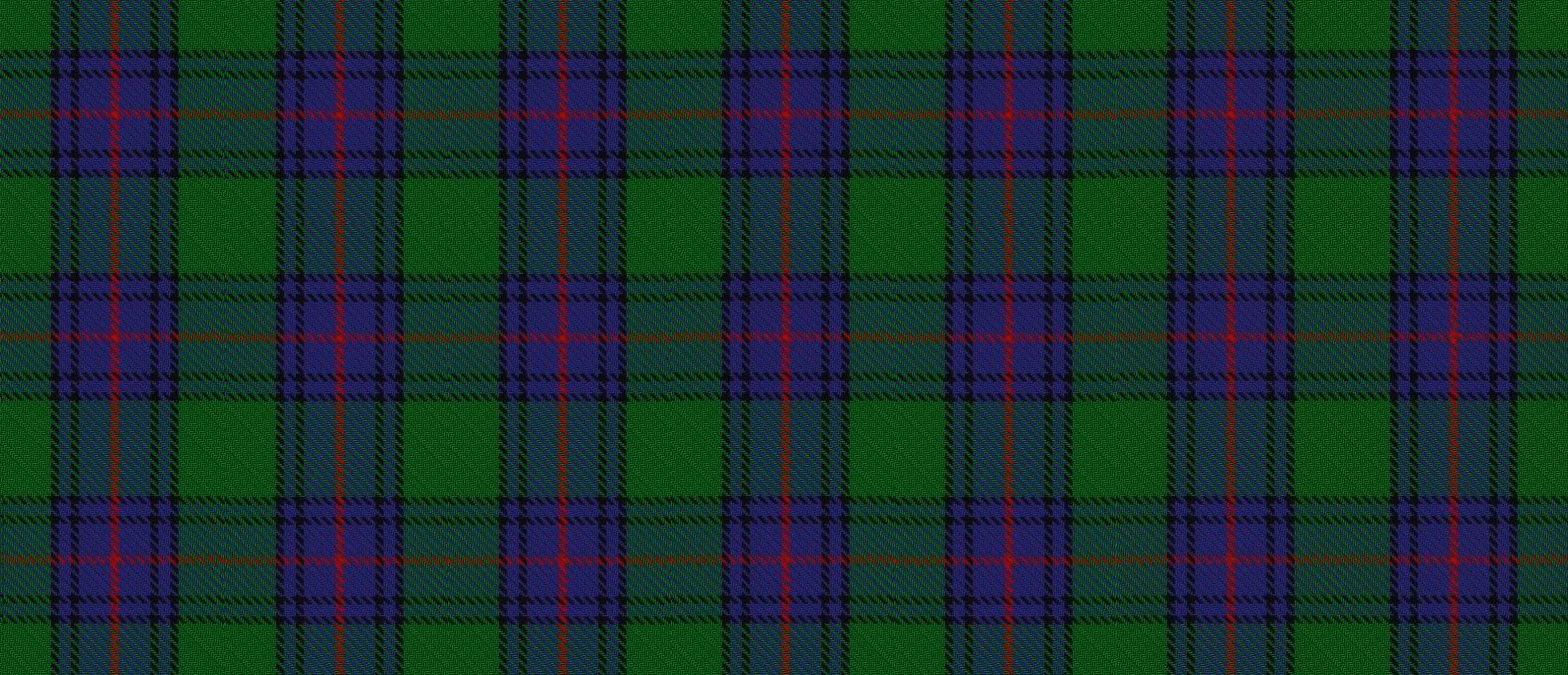
 The information presented on this page is not intended to be viewed as a totally comprehensive study of the clans. The information contained in the table below was culled from a number of sources and is simply intended to give visitors a basic idea about the clans. More detailed studies of various individual clans are available elsewhere on official clan websites (See the Scottish Lore Links page).